Since SOMA, a project I've worked on, is in the news. I'd be remiss in failing to mention that it has also been on popular television. The CBS crime drama Numb3rs mentioned it (although it failed to give the University of Maryland credit.)
Also - as far as credit goes - I didn't conceive of, or build, the system. My contribution was interpreting the results.
Without further ado...here are the clips.
Tuesday, December 15, 2009


Calculated Terror - Mannes & Subrahmanian in Foreign Policy
Foreign Policy has just published an article I co-wrote with my colleague VS Subrahmanian discussing our work modeling the behavior of terrorist organizations. This piece focuses on our results on Hezbollah, which provide a credible explanation to Hezbollah's decision to keep the Israeli-Lebanese border quiet since the end of the 2006 war.
For more on our work, visit the website of my employer the Laboratory for Computational Cultural Dynamics. The specific system discussed here is the Stochastic Opponent Modeling Agents.
Foreign Policy
Argument
Calculated Terror
How a computer model predicts the future in some of the world's most volatile hotspots.
BY AARON MANNES, V.S. SUBRAHMANIAN | DECEMBER 15, 2009
On Oct. 27, a Katyusha rocket was fired from Lebanon and struck down in an open area outside the northern Israeli town of Kiryat Shmone. This was the ninth such rocket strike since the end of the 2006 war between Israel and Hezbollah. No group claimed responsibility for the attack, but smaller Palestinian groups hoping to spark another round of fighting are the most likely suspect. Hezbollah, despite its extreme anti-Israel politics, did not join the fight, even after Israeli counterstrikes.
The "Blue Line" separating Israel from Lebanon is one of the most volatile borders in the world. But predicting when this area, and other tense regions throughout the world, will erupt into violence often appears to be little more than guesswork. How can policymakers overcome their own biases and limited information to anticipate if an incident like the recent rocket strike on Israel will spark a larger conflict, like the 2006 war, or fizzle out?
Increasingly, the answer is: Develop a computer model from historical data. The University of Maryland's Laboratory for Computational Cultural Dynamics (LCCD) constructed one such model that predicted this period of quiet along the Israeli-Lebanese border, and also provides insight into Hezbollah's priorities. LCCD developed a framework, known as Stochastic Opponent Modeling Agents (SOMA), that examines historical data and automatically generates rules assessing the probability that a group will take certain actions under certain conditions.
SOMA examines historical data about the group's behavior and tries to find conditions such that, when the condition is true, the group takes a given action with high probability and, when the condition is false, the group takes the action with very low probability. A human analyst could make these connections when there are relatively few variables being tracked. But when there are dozens of variables there are millions of such possible rules -- far more than an analyst can process. This is often the case in the interconnected world of Middle East politics, where events are shaped by the actions of many actors working in a diverse array of countries.
SOMA rules have also been extracted on the behavior of other Middle Eastern groups. Hamas, for example, is twice as likely to commit kidnappings during periods of conflict with other Palestinian organizations (the probability increases from approximately 33 percent to 67 percent). If another round of Fatah-Hamas fighting erupts in the West Bank, this may present a new challenge for Israeli security. While the rules had not been extracted in 2006, it is worth noting that the Israeli soldier Galid Shalit was kidnapped as the conflict between Hamas and Fatah expanded after the 2006 Palestinian elections.
SOMA is not specifically designed to model the behavior or Hezbollah or even of terrorist organizations -- it has also examined the behaviors of various actors in the Afghan drug trade under different circumstances. This model was built on a hypothetical situation, not systematically gathered data, but demonstrates the way in which SOMA can be applied to a broad range of conflicts and scenarios. The analysis showed that frequently used strategies such as burning poppy fields and destroying drug labs in Afghanistan are unlikely to lead to a long-term decline in the Afghan drug trade.
Models require data, and limitations of that data can limit the accuracy of a system such as SOMA. For the analysis of Hezbollah (and several other groups) SOMA used the Minorities at Risk Organization Behavior (MAROB) data set created at the University of Maryland's Center for International Development and Conflict Management. MAROB identifies factors that motivate members of ethnic minorities to form activist organizations and move from conventional politics to terrorism. MAROB has systematically collected information on more than 150 variables from over 100 organizations across the Middle East during the last several decades. Hezbollah is one of the organizations profiled; the data collected covers Hezbollah from its 1982 founding through 2004.
In examining the rules generated by SOMA about Hezbollah's behavior, the most striking finding was the correlation between Hezbollah attacks on Israeli citizens and Lebanese elections. Since the re-establishment of Lebanon's parliamentary democracy in 1992, there was a 62 percent chance Hezbollah would target Israeli civilians (primarily through rocket attacks) in any given year through 2004. In off-election years the likelihood jumped to 78 percent, while in election years the probability was negligible. The one election year in which Hezbollah fired rockets at Israel was 1996. Though Hezbollah won a propaganda victory when Israel's response caused heavy Lebanese civilian casualties, the organization lost parliament seats in the 1996 elections. Hezbollah has since sought to keep its fighting with Israel within certain boundaries, avoided major escalations during election years, and re-emphasized its provision of social services within Lebanon.
The test for any model is whether or not its predictions hold. During Israel's Operation Cast Lead against Hamas in Gaza, there was concern that Hezbollah would initiate a second front to aid its ally. But Hezbollah offered only rhetorical support to Hamas. During the Gaza operation, a few rockets were fired from Lebanon into Israel and Hezbollah quickly and credibly denied responsibility. With an election later in the year, Hezbollah determined that it could not risk renewed violence with Israel -- particularly in the wake of the 2006 war, which many Lebanese felt was brought on by Hezbollah and that left much of south Lebanon in ruin.
Beyond its predictive value, these findings provide insight into Hezbollah's behavior and priorities. The SOMA results highlight how Hezbollah needs to maintain its position within Lebanon's political system, even if that restricts its ability to wage war on Israel. Though the conflict with Israel is the organization's raison d'être, Hezbollah's leadership has taken steps -- such as participating in the Lebanese parliament -- to prevent the party from being politically isolated.
However, this balancing act is becoming more difficult to maintain, as these two aspects of Hezbollah are coming into increasing conflict. The 2006 war inflicted massive costs on the Lebanese people, which has made them less likely to tolerate Hezbollah's foreign adventurism. Earlier in October an explosion at a private home revealed the presence of a Hezbollah arms cache (Hezbollah disputes this). This incident reminded the Lebanese that Hezbollah remains capable of launching another round of fighting with Israel, and raised the specter of the conflict being sparked by accident. The recent Israeli seizure of a cargo ship carrying nearly 400 tons of weapons apparently intended for Hezbollah raised further concerns that Lebanon could again become a battlefield between foreign powers. If one appreciates that Lebanese popular opinion exerts a strong influence on Hezbollah's actions, it should be clearer that another Israel-Hezbollah war remains unlikely.
SOMA's analysis of Hezbollah's behavior serves both analysts and policymakers by making a specific prediction about the group's likely actions, and also by highlighting this important underlying dynamic. As the data collected expands in breadth and depth, it may become possible to make specific predictions about how, when, and under what circumstances regional changes will occur. While the Oct. 27 rocket strike on northern Israel seems to be just the sort of incident which could cause an unpredictable chain reaction in the region, in the future its repercussions may largely be known before the rocket leaves the ground.
Aaron Mannes, a researcher at the University of Maryland's Laboratory of Computational Cultural Dynamics, is a doctoral student at the University of Maryland's School of Public Policy. V.S. Subrahmanian, a professor of computer science, is the director of the University of Maryland Institute for Advanced Computer Studies.
For more on our work, visit the website of my employer the Laboratory for Computational Cultural Dynamics. The specific system discussed here is the Stochastic Opponent Modeling Agents.
Foreign Policy
Argument
Calculated Terror
How a computer model predicts the future in some of the world's most volatile hotspots.
BY AARON MANNES, V.S. SUBRAHMANIAN | DECEMBER 15, 2009
On Oct. 27, a Katyusha rocket was fired from Lebanon and struck down in an open area outside the northern Israeli town of Kiryat Shmone. This was the ninth such rocket strike since the end of the 2006 war between Israel and Hezbollah. No group claimed responsibility for the attack, but smaller Palestinian groups hoping to spark another round of fighting are the most likely suspect. Hezbollah, despite its extreme anti-Israel politics, did not join the fight, even after Israeli counterstrikes.
The "Blue Line" separating Israel from Lebanon is one of the most volatile borders in the world. But predicting when this area, and other tense regions throughout the world, will erupt into violence often appears to be little more than guesswork. How can policymakers overcome their own biases and limited information to anticipate if an incident like the recent rocket strike on Israel will spark a larger conflict, like the 2006 war, or fizzle out?
Increasingly, the answer is: Develop a computer model from historical data. The University of Maryland's Laboratory for Computational Cultural Dynamics (LCCD) constructed one such model that predicted this period of quiet along the Israeli-Lebanese border, and also provides insight into Hezbollah's priorities. LCCD developed a framework, known as Stochastic Opponent Modeling Agents (SOMA), that examines historical data and automatically generates rules assessing the probability that a group will take certain actions under certain conditions.
SOMA examines historical data about the group's behavior and tries to find conditions such that, when the condition is true, the group takes a given action with high probability and, when the condition is false, the group takes the action with very low probability. A human analyst could make these connections when there are relatively few variables being tracked. But when there are dozens of variables there are millions of such possible rules -- far more than an analyst can process. This is often the case in the interconnected world of Middle East politics, where events are shaped by the actions of many actors working in a diverse array of countries.
SOMA rules have also been extracted on the behavior of other Middle Eastern groups. Hamas, for example, is twice as likely to commit kidnappings during periods of conflict with other Palestinian organizations (the probability increases from approximately 33 percent to 67 percent). If another round of Fatah-Hamas fighting erupts in the West Bank, this may present a new challenge for Israeli security. While the rules had not been extracted in 2006, it is worth noting that the Israeli soldier Galid Shalit was kidnapped as the conflict between Hamas and Fatah expanded after the 2006 Palestinian elections.
SOMA is not specifically designed to model the behavior or Hezbollah or even of terrorist organizations -- it has also examined the behaviors of various actors in the Afghan drug trade under different circumstances. This model was built on a hypothetical situation, not systematically gathered data, but demonstrates the way in which SOMA can be applied to a broad range of conflicts and scenarios. The analysis showed that frequently used strategies such as burning poppy fields and destroying drug labs in Afghanistan are unlikely to lead to a long-term decline in the Afghan drug trade.
Models require data, and limitations of that data can limit the accuracy of a system such as SOMA. For the analysis of Hezbollah (and several other groups) SOMA used the Minorities at Risk Organization Behavior (MAROB) data set created at the University of Maryland's Center for International Development and Conflict Management. MAROB identifies factors that motivate members of ethnic minorities to form activist organizations and move from conventional politics to terrorism. MAROB has systematically collected information on more than 150 variables from over 100 organizations across the Middle East during the last several decades. Hezbollah is one of the organizations profiled; the data collected covers Hezbollah from its 1982 founding through 2004.
In examining the rules generated by SOMA about Hezbollah's behavior, the most striking finding was the correlation between Hezbollah attacks on Israeli citizens and Lebanese elections. Since the re-establishment of Lebanon's parliamentary democracy in 1992, there was a 62 percent chance Hezbollah would target Israeli civilians (primarily through rocket attacks) in any given year through 2004. In off-election years the likelihood jumped to 78 percent, while in election years the probability was negligible. The one election year in which Hezbollah fired rockets at Israel was 1996. Though Hezbollah won a propaganda victory when Israel's response caused heavy Lebanese civilian casualties, the organization lost parliament seats in the 1996 elections. Hezbollah has since sought to keep its fighting with Israel within certain boundaries, avoided major escalations during election years, and re-emphasized its provision of social services within Lebanon.
The test for any model is whether or not its predictions hold. During Israel's Operation Cast Lead against Hamas in Gaza, there was concern that Hezbollah would initiate a second front to aid its ally. But Hezbollah offered only rhetorical support to Hamas. During the Gaza operation, a few rockets were fired from Lebanon into Israel and Hezbollah quickly and credibly denied responsibility. With an election later in the year, Hezbollah determined that it could not risk renewed violence with Israel -- particularly in the wake of the 2006 war, which many Lebanese felt was brought on by Hezbollah and that left much of south Lebanon in ruin.
Beyond its predictive value, these findings provide insight into Hezbollah's behavior and priorities. The SOMA results highlight how Hezbollah needs to maintain its position within Lebanon's political system, even if that restricts its ability to wage war on Israel. Though the conflict with Israel is the organization's raison d'être, Hezbollah's leadership has taken steps -- such as participating in the Lebanese parliament -- to prevent the party from being politically isolated.
However, this balancing act is becoming more difficult to maintain, as these two aspects of Hezbollah are coming into increasing conflict. The 2006 war inflicted massive costs on the Lebanese people, which has made them less likely to tolerate Hezbollah's foreign adventurism. Earlier in October an explosion at a private home revealed the presence of a Hezbollah arms cache (Hezbollah disputes this). This incident reminded the Lebanese that Hezbollah remains capable of launching another round of fighting with Israel, and raised the specter of the conflict being sparked by accident. The recent Israeli seizure of a cargo ship carrying nearly 400 tons of weapons apparently intended for Hezbollah raised further concerns that Lebanon could again become a battlefield between foreign powers. If one appreciates that Lebanese popular opinion exerts a strong influence on Hezbollah's actions, it should be clearer that another Israel-Hezbollah war remains unlikely.
SOMA's analysis of Hezbollah's behavior serves both analysts and policymakers by making a specific prediction about the group's likely actions, and also by highlighting this important underlying dynamic. As the data collected expands in breadth and depth, it may become possible to make specific predictions about how, when, and under what circumstances regional changes will occur. While the Oct. 27 rocket strike on northern Israel seems to be just the sort of incident which could cause an unpredictable chain reaction in the region, in the future its repercussions may largely be known before the rocket leaves the ground.
Aaron Mannes, a researcher at the University of Maryland's Laboratory of Computational Cultural Dynamics, is a doctoral student at the University of Maryland's School of Public Policy. V.S. Subrahmanian, a professor of computer science, is the director of the University of Maryland Institute for Advanced Computer Studies.
Thursday, November 19, 2009
Conflict & Computer Science
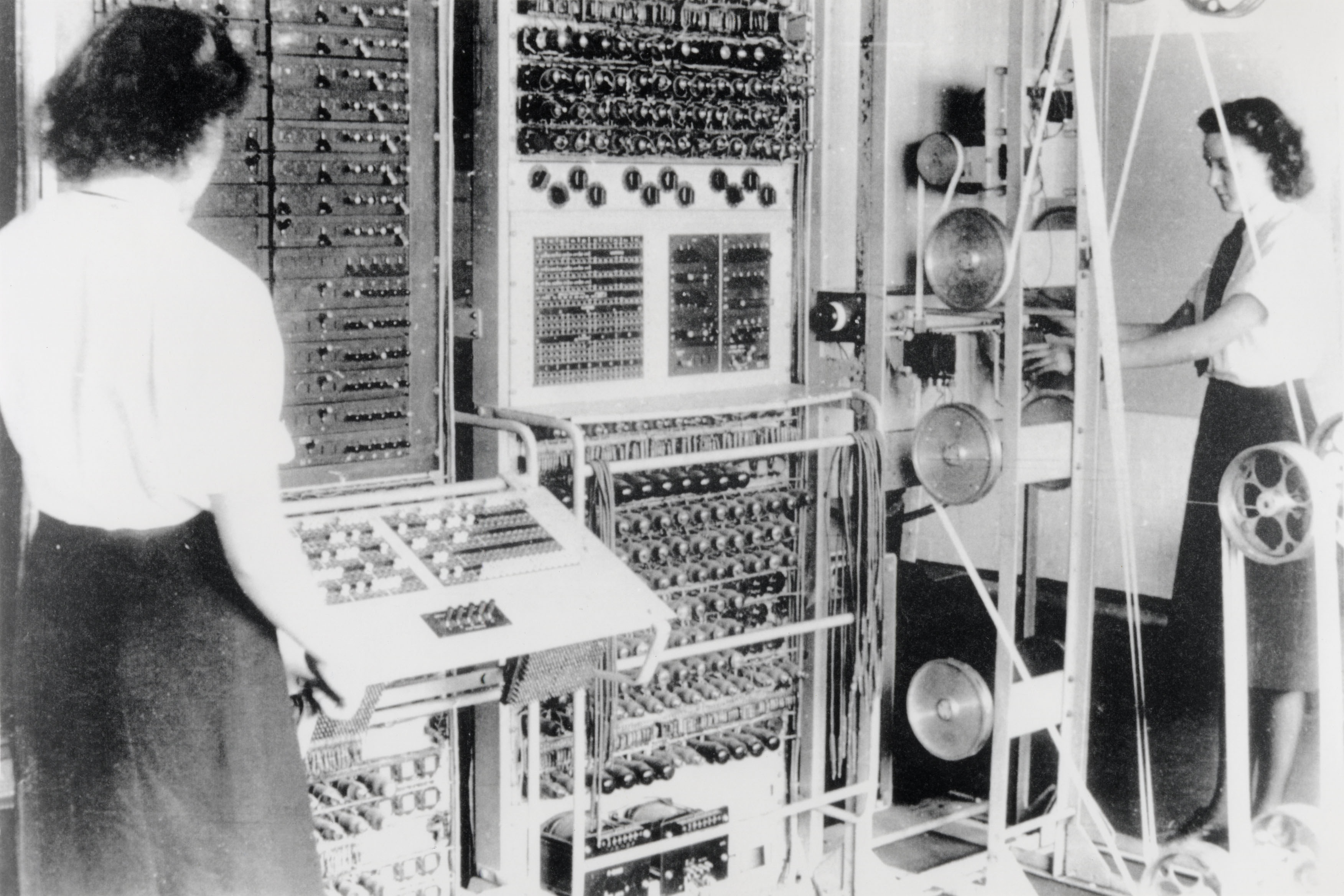 Conflict has often been a driver for technological advances and computer science has been no exception. The requirements of code breaking during World War II led to the construction of Colossus – the first totally electronic computer device, while the Internet was originally constructed to provide a secure communications network for the military in the event of a nuclear war. While terrorist use of technology, and particularly the Internet, receives tremendous press, the current conflict is also sparking important developments in computer science that will have impacts far beyond the security realm.
My employer, the Laboratory for Computational Cultural Dynamics (LCCD) at the University of Maryland is one group seeking to develop the theory and algorithms required for tools to support decision-making in cultural contexts. LCCD has developed numerous systems including T-Rex, which can rapidly scan text in several languages and convert it into a database and SOMA (Stochastic Opponent Modeling Agents) which can extract rules of likely behaviors by organizations from their past behaviors.
LCCD sponsors an annual conference, the International Conference on Computational Cultural Dynamics (ICCCD2009) – to be held this year on December 7-8 at the University of Maryland. Papers being presented include efforts to model insurgencies as well as piracy in Somalia, a tool used to map the Indonesian blogosphere, and SCARE (Spatial Cultural Abduction Reasoning Engine) which can help predict the locations of weapons caches in an urban environment. (See the full program here.)
Augmenting the Mind
The human brain is an impressive system, which also builds models. In some regards it far exceeds anything on the horizon in the realm of computer science. The ability of human beings to take information and place it in context and draw conclusions from it is profound. We build complex models of how the world works in order to function in it. But computers can process some forms of data far faster than humans and will do so systematically. Human minds cannot quickly process large quantities of data. In attempting to make sense of large amounts of information a human beings may discount or ignore information that does not fit in their model of how the world works – or alternately draw significant conclusions based on a very limited amount of data. Imagine an economist ignoring issues of ethnic identity in analyzing a nation’s policies or a political philosopher focusing on ideology while ignoring logistics in studying a terrorist group’s behavior. In short, computer systems are capable of substantially augmenting the power of human reason.
Things to Come
The impacts of these technologies will be profound. Real-time data collection and processing will potentially improve decision-making in many ways. Beyond providing better intelligence, it will allow the creation of in-depth virtual environments, which facilitate training to operate in different cultures. The Marines and Army have built mock Afghan and Iraqi villages staffed by actors for this kind of training. These are terrific facilities, but a computer simulation could inexpensively augment the real world training.
According to the late Alexander George, a renowned scholar of the presidency, many foreign policy accidents have occurred because leaders were unable to see the situation from the perspective of their counterpart. Leaders make assumptions about their opposite number and his (or her) actions based on an intuited model of their behavior. Models not operating on limiting assumptions may provide alternate explanations for behaviors and thereby give leaders the insight to avoid escalating conflicts that arose from misunderstandings.
But these systems will also have civilian applications. Game theory systems used to predict the behavior of adversaries may also be used to understand the behavior of business competitors. Tools that can analyze the opinions expressed on jihadi websites could also be used to analyze public opinion for marketing research. Models that identify the outbreak of terrorism and insurgency may also be turned to studying the outbreak of disease.
But this focuses on applications designed for policy-makers – and no doubt there will be many such tools. But only twenty years ago, very few people imagined a ubiquitous, international system that facilitated instantaneous communications and put vast amounts of information virtually at every user’s fingertips. Models and game theory will not remain in the realm of executives and professional analysts. They will also become everyday tools used by regular people to better plan their activities and make decisions about their lives.
In this vein, ICCCD2009 could prove to be a fascinating glimpse into the future.
Friday, November 13, 2009
Bureaucracy, Culture & Ft. Hood Attacks
Bureaucracy, Culture & Ft. Hood Attacks
The Fort Hood attack was an intelligence failure, just like 9/11 and so many others before. In retrospect, it all seems obvious – these kinds of failures always do. It is easy to blame bureaucratic inertia, but it is also unfair. Large organizations need procedures to function. Priorities must be set and decisions have to be made and implemented.
Examining the system failure is revealing, both about the challenges in preventing these kinds of tragedies but also in how they reveal some of our society’s core values.
Army: Major Problems
It is now clear that Major Hasan’s colleagues were concerned about his actions and behavior. But there were limits to what they could do about. Firing an Army Major is a very big deal. It is now clear that Hasan’s colleagues had doubts about his commitment to the military and about his work habits. But, informally, they judged that he was not dangerous. Consider the situation from their point of view. First, Hasan was a psychiatrist – it is understandable that Hasan’s colleagues would assume that an individual practicing a profession rooted caring, healing, and empathy would not be likely to become a murderer (Hannibal Lector is a fictional character.) But also consider the bureaucratic challenges. Hasan’s relatives reported that when Hasan made informal inquiries about leaving the Army:
No doubt, Hasan’s colleagues are no wishing that they had pursued this process nonetheless and in the future officers faced with comparable situations undoubtedly will do whatever is necessary to remove individuals. But the organizational procedures that make it difficult to remove officers exist to protect them from the arbitrary whims of their superiors. This reflects our cultural belief in meritocracy over patronage and it is a value that has served us well.
FBI: By the Book
Hasan had also garnered the attention of the FBI-led Joint Terrorism Task Force (JTTF.) Here too, necessary organizational procedures failed to make the crucial connection. The FBI has to prioritize threats – the agency lacks the resources to track down every rumor and case of idle chatter (and an agency capable and mandated to do so would end up resembling STASI or the KGB.) This article from NPR’s All Things Considered gives some insight into the FBI’s criteria – the essence is “The closer the link to al-Qaida, the more serious the plot.” There are three levels, the people directly linked to al-Qaida (travel to Pakistan for training followed up by regular communications is seen as a big red flag.) The second level threats are plots linked to al-Qaida affiliates. The third level threats are the “angry young men” that are often radicalized on the Internet. Hasan would have been a “level three” except that he was a bit older then the usual recruits and his exchanges with radical cleric Anwar al-Aulaqi did not appear to be terribly angry. The FBI determined that he was not a threat.
The fact that the JTTF became aware of Hassan’s email exchange indicates what an enormous volume of material they are required to analyze. Priorities have to be set. Had the analysts gone one step further and spoken to Hasan’s colleagues there is a chance that the dots would have been connected. But the JTTF’s judgment was not an irrational one. Future instances of military personnel corresponding with radical Islamists will undoubtedly be bright red flags in the future. Organizations (like Generals) always prepare for the last crisis. Just as a 9/11-type plot will probably not be successful in the future, it is probable that the appropriate agencies will be able to head off tragedies like the Fort Hood murders in the future.
The question of what is next remains.
The Fort Hood attack was an intelligence failure, just like 9/11 and so many others before. In retrospect, it all seems obvious – these kinds of failures always do. It is easy to blame bureaucratic inertia, but it is also unfair. Large organizations need procedures to function. Priorities must be set and decisions have to be made and implemented.
Examining the system failure is revealing, both about the challenges in preventing these kinds of tragedies but also in how they reveal some of our society’s core values.
Army: Major Problems
It is now clear that Major Hasan’s colleagues were concerned about his actions and behavior. But there were limits to what they could do about. Firing an Army Major is a very big deal. It is now clear that Hasan’s colleagues had doubts about his commitment to the military and about his work habits. But, informally, they judged that he was not dangerous. Consider the situation from their point of view. First, Hasan was a psychiatrist – it is understandable that Hasan’s colleagues would assume that an individual practicing a profession rooted caring, healing, and empathy would not be likely to become a murderer (Hannibal Lector is a fictional character.) But also consider the bureaucratic challenges. Hasan’s relatives reported that when Hasan made informal inquiries about leaving the Army:
They told him that he would be allowed out only if Rumsfeld himself O.K.’d it..This may be a slight exaggeration, but removing Hasan would certainly have required authorization from people several levels higher in the chain of command – and the bases for doing so were not evident. What was clear was that Hasan was odd and said disturbing things and that he did not appear devoted to the job and the Army. Virtually every bureaucracy ends up with at least a few such characters. Usually they are slowly eased out. To fire them, without clear evidence of criminal activity, is much harder. It would have taken enormous amounts of time and since Hassan was a Major, General officers would need to have been involved. There were obvious incentives for easing Hasan out, rather than attempting to dismiss him.
No doubt, Hasan’s colleagues are no wishing that they had pursued this process nonetheless and in the future officers faced with comparable situations undoubtedly will do whatever is necessary to remove individuals. But the organizational procedures that make it difficult to remove officers exist to protect them from the arbitrary whims of their superiors. This reflects our cultural belief in meritocracy over patronage and it is a value that has served us well.
FBI: By the Book
Hasan had also garnered the attention of the FBI-led Joint Terrorism Task Force (JTTF.) Here too, necessary organizational procedures failed to make the crucial connection. The FBI has to prioritize threats – the agency lacks the resources to track down every rumor and case of idle chatter (and an agency capable and mandated to do so would end up resembling STASI or the KGB.) This article from NPR’s All Things Considered gives some insight into the FBI’s criteria – the essence is “The closer the link to al-Qaida, the more serious the plot.” There are three levels, the people directly linked to al-Qaida (travel to Pakistan for training followed up by regular communications is seen as a big red flag.) The second level threats are plots linked to al-Qaida affiliates. The third level threats are the “angry young men” that are often radicalized on the Internet. Hasan would have been a “level three” except that he was a bit older then the usual recruits and his exchanges with radical cleric Anwar al-Aulaqi did not appear to be terribly angry. The FBI determined that he was not a threat.
The fact that the JTTF became aware of Hassan’s email exchange indicates what an enormous volume of material they are required to analyze. Priorities have to be set. Had the analysts gone one step further and spoken to Hasan’s colleagues there is a chance that the dots would have been connected. But the JTTF’s judgment was not an irrational one. Future instances of military personnel corresponding with radical Islamists will undoubtedly be bright red flags in the future. Organizations (like Generals) always prepare for the last crisis. Just as a 9/11-type plot will probably not be successful in the future, it is probable that the appropriate agencies will be able to head off tragedies like the Fort Hood murders in the future.
The question of what is next remains.
Friday, October 16, 2009
Lashkar-e-Taiba - Pakistan's Hezbollah
One group absent from the concoction of Punjabi groups joining the Pashtun Taliban rebellion is Lashkar-e-Toiba (LeT). Although it recruits from the same general area, the other groups are Deobandi (Pakistan’s homegrown Islamic extremists) whereas LeT is Dar Ahl Hadith, which is basically the Pakistani-offshoot of the Saudi Wahabis. The theological divisions are not enormous and there are links. But LeT appears to be more careful and disciplined in its strategic thinking. It has not been involved in significant violence within Pakistan and has not taken on the Pakistani government. It also appears to have independent funding sources (initial stake money was apparently from Saudi Arabia, but it has since developed its own fund-raising networks.) While there are far fewer Ahl Hadith adherents in Pakistan then Deobandis (or Barelvis or Shia), LeT itself is one of the larger groups – the ISI reports they have 150,000 members. LeT runs schools, hospitals, and other social services along with an extensive print media empire. In short, it is a Hezbollah-like organization with multiple facets, the ability to innovate tactically, and choose its operations strategically (like the November 2008 attacks in Mumbai.)
Saeed Stands Alone
This is important background to the recent Pakistani court decision to dismiss incitement charges against LeT leader Hafiz Mohammed Saeed. B. Raman has a fine analysis here. A few additional points are in order. Westerners love the independent Pakistani judiciary when it is “democratic” but not when it is actually doing its job under the law. The real issue is the way in which Saeed was prosecuted. The charges were incitement – these are loser charges that only make Saeed more popular. Incitement against India is in theory illegal – but is also admired by many in Pakistan.
Saeed is officially head of Jamaat-ud-Dawa, which officially has nothing to do with LeT (see previous post.) One imagines evidence could be produced to prove this lack of connection false – but the Pakistani government does not seem interested in producing it. At this point, Pakistan cannot afford to open up a second front against the LeT – not with serious shooting in Wazirstan and the likelihood that operations in the Punjabi heartland will be necessary. The Pakistani army faces several challenges, first every unit deployed is a unit not facing India (the military’s core obsession), second the military is not designed for counter-insurgency operations, third much of the Pakistani army is Punjabi so operations there are fraught with potential morale problems.
It is unknown if the Pakistani high command views LeT as an asset or a problem, but given all of their immediate problems and the LeT’s scrupulous avoidance of taking on the Pakistani government it is easy to see why Pakistani leaders would avoid this particular fight.
They will not be able to avoid it forever.
Saeed Stands Alone
This is important background to the recent Pakistani court decision to dismiss incitement charges against LeT leader Hafiz Mohammed Saeed. B. Raman has a fine analysis here. A few additional points are in order. Westerners love the independent Pakistani judiciary when it is “democratic” but not when it is actually doing its job under the law. The real issue is the way in which Saeed was prosecuted. The charges were incitement – these are loser charges that only make Saeed more popular. Incitement against India is in theory illegal – but is also admired by many in Pakistan.
Saeed is officially head of Jamaat-ud-Dawa, which officially has nothing to do with LeT (see previous post.) One imagines evidence could be produced to prove this lack of connection false – but the Pakistani government does not seem interested in producing it. At this point, Pakistan cannot afford to open up a second front against the LeT – not with serious shooting in Wazirstan and the likelihood that operations in the Punjabi heartland will be necessary. The Pakistani army faces several challenges, first every unit deployed is a unit not facing India (the military’s core obsession), second the military is not designed for counter-insurgency operations, third much of the Pakistani army is Punjabi so operations there are fraught with potential morale problems.
It is unknown if the Pakistani high command views LeT as an asset or a problem, but given all of their immediate problems and the LeT’s scrupulous avoidance of taking on the Pakistani government it is easy to see why Pakistani leaders would avoid this particular fight.
They will not be able to avoid it forever.
Pakistan's Jihadi Stew
The aftermath of the attack on the Pakistani military’s GHQ earlier this week has brought attention to the complex stew of jihadi groups running around the Punjab. Imtiaz Gul provides an overview at Foreign Policy while the venerable B. Raman provides another at Outlook India. The story starts with the Saudis supporting anti-Shia groups in Pakistan to counter Iranian-backed Shia militancy. This was exacerbated by local animosities in regions were Pakistan’s Shia minority were wealthy landowners. The main anti-Shia group was Sipah-e-Sahaba Pakistan (SSP). Reportedly it received substantial state support under General Zia who wanted to counter his political rivals. SSP became involved in politics and spun-off violent groups, most notably Lashkar-e-Jhangvi (LeJ) in 1996. Supposedly there is no connection between the political SSP and the terrorist LeJ. This is an organizational maneuver that has been repeated endlessly in the Pakistani jihadi milieu. Supposedly, both of these groups have been banned – but banned groups in Pakistan never seem to disappear, they just change their names.
The anti-Shia groups also worked with the Pakistani government during the Afghan war, where they forged links with the Arab jihadis and the Afghans. When Pakistan began supporting jihadi groups to fight in Kashmir the anti-Shia groups were an entryway. An effective unraveling of the Kashmiri groups is an enormous task – a small piece of the picture can be seen here. Individuals often move between groups – either because the group is shifting identity because of too much international attention or just for better “career opportunities.” Jaish-e-Mohammed was founded after Harkat ul-Ansar official Maulana Masood Azhar was freed from Indian prison and found that he was a popular figure. So rather then rejoin his old outfit, now renamed Harkat ul-Mujahideen (after Harkat ul-Ansar became a banned terrorist organization) Azhar founded JeM. Azhar was a model jihadi entrepreneur, with the venture capital provided (reportedly) by the ISI.
The anti-Shia groups also worked with the Pakistani government during the Afghan war, where they forged links with the Arab jihadis and the Afghans. When Pakistan began supporting jihadi groups to fight in Kashmir the anti-Shia groups were an entryway. An effective unraveling of the Kashmiri groups is an enormous task – a small piece of the picture can be seen here. Individuals often move between groups – either because the group is shifting identity because of too much international attention or just for better “career opportunities.” Jaish-e-Mohammed was founded after Harkat ul-Ansar official Maulana Masood Azhar was freed from Indian prison and found that he was a popular figure. So rather then rejoin his old outfit, now renamed Harkat ul-Mujahideen (after Harkat ul-Ansar became a banned terrorist organization) Azhar founded JeM. Azhar was a model jihadi entrepreneur, with the venture capital provided (reportedly) by the ISI.
Tuesday, October 13, 2009
Man vs. Mosquito: The Ultimate Insurgent

The past week I celebrated the Jewish holiday Sukkot. During this holiday, observant Jews “dwell” in their sukkah – a temporary structure. This “dwelling,” depending on climate and inclination can vary from formally living in it to merely taking some meals in the sukkah. Personally I like to spend as much time in it as possible. One side effect is that our back door is open a lot and mosquitos get in our house. My wife does not like mosquitos (but they love her), so I sat up one night and tried to hunt down the ones that got into our house. Not easy. Fast and hard to spot, my most effective anti-mosquito tactic was to sit very still and let them get a taste of my arm. A draining, tedious strategy, and in the process I got bored and had a few beers which only reduced my effectiveness. If I had had to deal with more than a handful I would have had to turn to chemical warfare.
The experience brought to mind the classic line from Robert Taber’s 1965 classic on counter-insurgency, The War of the Flea: Guerilla Warfare in Theory and Practice
Analogically, the guerilla fights the war of the flea, and his military enemy suffers the dog’s disadvantages: too much to defend;too small, ubiquitous, and agile an enemy to come to grips with. If the war continues long enough - this is the theory – the dog succumbs to exhaustion and anemia without ever having found anything on which to close its jaws or rake with its claws.It was a humbling experience. I guess the one difference is that insurgents can be deterred and co-opted. Mosquitos are remorseless blood-sucking machines.
Subscribe to:
Posts (Atom)