NEWS IN BRIEF
Local Man Foremost Expert On What The Terrorists Should Do If They Really Want To Hurt Us
NOVEMBER 10, 2010 | ISSUE 46•45
BIRMINGHAM, AL—Area feed store manager and local terrorist expert Wendell Butler offered up another one of his brilliant theories Friday outlining exactly what the terrorists should do if they really want to hurt the United States. "I'll tell you what would absolutely demoralize us is if they hit Disneyland," said the 48-year-old high school graduate, whose vast knowledge of how terrorists operate and what the consequences of their potential actions would be is truly unmatched. "With all the families there it would just be devastating. And it's Disneyland, so symbolically that would be like the ultimate desecration of everything American." The razor-sharp Butler then spent the next two hours applying his insightful analysis of global terrorism and its effects to hypothetical attacks on water treatment facilities, hospitals, and the Academy Awards.
Thursday, November 18, 2010


Monday, November 8, 2010
Review of "Winning the Long War" in Journal of Middle East and Africa
The Journal of Middle East and Africa has just published my review of Ilan Berman's Winning the Long War: Retaking the Offensive Against Radical Islam.
Winning The Long War
Retaking the Offensive Against Radical Islam
by Ilan Berman
Rowman & Littlefield, 2009. 140 pp. $29.95
Reviewed by Aaron Mannes
Journal of the Middle East and Africa
Fall 2010
Stating that the threat of radical Islam cannot be defeated by force alone is easy, actually spelling out an alternative strategy is more difficult. Ilan Berman, vice president of the American Foreign Policy Council and editor of the Journal of International Security Affairs, has ably addressed this challenge with his Winning the Long War: Retaking the Offensive against Radical Islam. This slender volume briskly describes a wide range of "non-kinetic" means that could be deployed to mitigate the Islamist threat. As a byproduct, it is also a chronicle of the Bush administration's failure to effectively leverage these national assets. Perhaps the greatest weakness of this timely and useful book is its brevity. This brevity makes developing a new national counter-terror strategy seem deceptively simple when there are substantial political and institutional barriers to its implementation.

Berman begins by identifying three separate strategic challenges: al-Qaeda and its many affiliates, Iran and its allies, and the undecided Muslim masses. Berman's book is strongest in its proposals for countering Tehran's regional power play (a subject on which Berman has written extensively, most notably in his previous book Tehran Rising: Iran's Challenge to the United States). But he provides a range of policy prescriptions applicable to each of these fronts.
No think tank event on terrorism and radical Islam is complete without a call to win the war of ideas—but few analysts provide much guidance on how to achieve this goal. Berman explains that missteps by al-Qaeda and the Iranian regime provide the United States with rhetorical ammunition. With a penchant for spilling Muslim blood and a doctrine offering no solutions to the real problems facing the Muslim world, al-Qaeda's support in the Muslim world has been in decline. In Iran, the government has failed to deliver basic services or economic prosperity. Yet American public diplomacy has been slow to capitalize on these trends or to offer compelling counter-narratives. Iranian history provides ready-made counter-narratives to the Shia radicalism of the Iranian regime. Nor has the United States effectively collaborated with moderate Muslim leaders or the growing number of once radical clerics who have rejected al-Qaeda.
American efforts at public diplomacy have also not mastered the media. American established television and radio are also-rans in the dynamic Middle Eastern media environment, and American public diplomacy has been slow to react to events, generally ceding the initiative to al-Qaeda and its allies.
Beyond the failure to develop a message or master the medium is a failure to spend money. Berman reports that funding for public diplomacy is still not at Cold War levels. The 2008 budget for public diplomacy was only $1.15 billion, with about $154 million directed to the Middle East. In the context of the United States government, these are tiny expenditures. No matter how good the message is, without adequate funding, the United States cannot hope to make its case to the world's population. Efforts to run an effective public diplomacy campaign face an important organizational hurdle. During the Cold War, the United States Information Agency (USIA) ran public diplomacy. When the Cold War ended, the USIA's functions were folded into the State Department. Public diplomacy and traditional diplomacy are very different missions and at Foggy Bottom the latter is the preferred task. If the United States is to have an effective international information campaign, public diplomacy may have to be moved out of the building.
In a chapter on economic levers possessed by the United States, Berman lists a range of options, particularly against Iran, which have not been exercised. With a tottering economy and high unemployment, Iran is extremely vulnerable to economic sanctions—particularly those targeting its dependence on imported gasoline. The United States, the world's largest economy, is well positioned to pressure companies that do business with the Iranian government. Even if the sanctions regime were imperfect, it would increase pressure on Iran's economy and further discredit the Islamic Republic's leaders. Beyond Iran, Berman suggests reforming USAID to systematically use development programs to support American allies and foster pro-American values. Many terrorist organizations provide social services. U.S. aid could help level the playing field and give vulnerable populations an alternative to radical Islam.
International law can also be turned to an asset for American counter-terror efforts. Developing a working definition of terrorism rooted in the laws of war that forbid targeting civilians would delegitamate some nonstate armed groups while giving others incentives to modify their tactics. It is easy to castigate the United Nations (UN), particularly in the wake of the massive corruption of the Oil for Food scandal. But replacing the UN is more expensive then reforming it and the UN does have important counter-terror capabilities that can operate in places where the United States is not welcome. As the largest donor to the UN, the United States is well positioned to press the UN to use its capabilities to better support international security needs.
Finally, Berman takes on the issue of democratization. As a counter-tactic and as a long-term goal it has much strength. But as a strategy it has limitations both because in many places the fundamental conditions for democracy are not in place so that Islamist movements may prevail at the ballot box and because it can bring the United States into conflict with existing allies and alienate potential ones. In a 2006 speech, then Vice President Cheney criticized Russia's turn from democracy. While Cheney's speech was correct in its content, it only succeeded in perturbing a major power (where the United States had limited options for supporting reform) that could have offered much needed support to U.S. counter-terror efforts. When the United States does promote democratic movements, it needs to maintain its focus to ensure that the movement's gains are consolidated. Finally, although regime change has been discredited due to the Iraq war, it should remain an option for the most dangerous and intransigent regimes such as Iran. Berman reminds readers that foreign intervention is by far the least preferred option; regimes can also fall or (as in the case of Libya) have a change of heart.
An enormous question overshadows this most useful book. Berman has done an excellent job outlining a comprehensive, nonmilitary counter-terror strategy. But most of the specific proposals discussed in Winning the Long War have been available to policy-makers since 9/11. What was the barrier to their implementation? In the United States, the president has limited powers of command and primarily has to persuade people (even his own appointees) to support his policies. All of Berman's proposals require the president to take on established interests. Reforming public diplomacy would require pressure on the State Department bureaucracy, while activating effective sanctions would entail standing up to powerful economic interests—both of these challenges pale in comparison to taking on the obstreperous UN mandarinate. All of these things can be done, but at a cost of presidential time and political capital. While presidential appointees will bear much of the burden of implementing new initiatives, without consistent and visible engagement from the top, the established interests in any policy arena will quickly isolate the president's men. Hopefully, Winning the Long War will persuade key policy-makers that, despite the challenges, they must devote the needed attention to implementing initiatives that deploy all aspects of American power—cultural, economic, and political. The long war demands nothing less.
Winning The Long War
Retaking the Offensive Against Radical Islam
by Ilan Berman
Rowman & Littlefield, 2009. 140 pp. $29.95
Reviewed by Aaron Mannes
Journal of the Middle East and Africa
Fall 2010
Stating that the threat of radical Islam cannot be defeated by force alone is easy, actually spelling out an alternative strategy is more difficult. Ilan Berman, vice president of the American Foreign Policy Council and editor of the Journal of International Security Affairs, has ably addressed this challenge with his Winning the Long War: Retaking the Offensive against Radical Islam. This slender volume briskly describes a wide range of "non-kinetic" means that could be deployed to mitigate the Islamist threat. As a byproduct, it is also a chronicle of the Bush administration's failure to effectively leverage these national assets. Perhaps the greatest weakness of this timely and useful book is its brevity. This brevity makes developing a new national counter-terror strategy seem deceptively simple when there are substantial political and institutional barriers to its implementation.
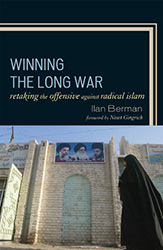
Berman begins by identifying three separate strategic challenges: al-Qaeda and its many affiliates, Iran and its allies, and the undecided Muslim masses. Berman's book is strongest in its proposals for countering Tehran's regional power play (a subject on which Berman has written extensively, most notably in his previous book Tehran Rising: Iran's Challenge to the United States). But he provides a range of policy prescriptions applicable to each of these fronts.
No think tank event on terrorism and radical Islam is complete without a call to win the war of ideas—but few analysts provide much guidance on how to achieve this goal. Berman explains that missteps by al-Qaeda and the Iranian regime provide the United States with rhetorical ammunition. With a penchant for spilling Muslim blood and a doctrine offering no solutions to the real problems facing the Muslim world, al-Qaeda's support in the Muslim world has been in decline. In Iran, the government has failed to deliver basic services or economic prosperity. Yet American public diplomacy has been slow to capitalize on these trends or to offer compelling counter-narratives. Iranian history provides ready-made counter-narratives to the Shia radicalism of the Iranian regime. Nor has the United States effectively collaborated with moderate Muslim leaders or the growing number of once radical clerics who have rejected al-Qaeda.
American efforts at public diplomacy have also not mastered the media. American established television and radio are also-rans in the dynamic Middle Eastern media environment, and American public diplomacy has been slow to react to events, generally ceding the initiative to al-Qaeda and its allies.
Beyond the failure to develop a message or master the medium is a failure to spend money. Berman reports that funding for public diplomacy is still not at Cold War levels. The 2008 budget for public diplomacy was only $1.15 billion, with about $154 million directed to the Middle East. In the context of the United States government, these are tiny expenditures. No matter how good the message is, without adequate funding, the United States cannot hope to make its case to the world's population. Efforts to run an effective public diplomacy campaign face an important organizational hurdle. During the Cold War, the United States Information Agency (USIA) ran public diplomacy. When the Cold War ended, the USIA's functions were folded into the State Department. Public diplomacy and traditional diplomacy are very different missions and at Foggy Bottom the latter is the preferred task. If the United States is to have an effective international information campaign, public diplomacy may have to be moved out of the building.
In a chapter on economic levers possessed by the United States, Berman lists a range of options, particularly against Iran, which have not been exercised. With a tottering economy and high unemployment, Iran is extremely vulnerable to economic sanctions—particularly those targeting its dependence on imported gasoline. The United States, the world's largest economy, is well positioned to pressure companies that do business with the Iranian government. Even if the sanctions regime were imperfect, it would increase pressure on Iran's economy and further discredit the Islamic Republic's leaders. Beyond Iran, Berman suggests reforming USAID to systematically use development programs to support American allies and foster pro-American values. Many terrorist organizations provide social services. U.S. aid could help level the playing field and give vulnerable populations an alternative to radical Islam.
International law can also be turned to an asset for American counter-terror efforts. Developing a working definition of terrorism rooted in the laws of war that forbid targeting civilians would delegitamate some nonstate armed groups while giving others incentives to modify their tactics. It is easy to castigate the United Nations (UN), particularly in the wake of the massive corruption of the Oil for Food scandal. But replacing the UN is more expensive then reforming it and the UN does have important counter-terror capabilities that can operate in places where the United States is not welcome. As the largest donor to the UN, the United States is well positioned to press the UN to use its capabilities to better support international security needs.
Finally, Berman takes on the issue of democratization. As a counter-tactic and as a long-term goal it has much strength. But as a strategy it has limitations both because in many places the fundamental conditions for democracy are not in place so that Islamist movements may prevail at the ballot box and because it can bring the United States into conflict with existing allies and alienate potential ones. In a 2006 speech, then Vice President Cheney criticized Russia's turn from democracy. While Cheney's speech was correct in its content, it only succeeded in perturbing a major power (where the United States had limited options for supporting reform) that could have offered much needed support to U.S. counter-terror efforts. When the United States does promote democratic movements, it needs to maintain its focus to ensure that the movement's gains are consolidated. Finally, although regime change has been discredited due to the Iraq war, it should remain an option for the most dangerous and intransigent regimes such as Iran. Berman reminds readers that foreign intervention is by far the least preferred option; regimes can also fall or (as in the case of Libya) have a change of heart.
An enormous question overshadows this most useful book. Berman has done an excellent job outlining a comprehensive, nonmilitary counter-terror strategy. But most of the specific proposals discussed in Winning the Long War have been available to policy-makers since 9/11. What was the barrier to their implementation? In the United States, the president has limited powers of command and primarily has to persuade people (even his own appointees) to support his policies. All of Berman's proposals require the president to take on established interests. Reforming public diplomacy would require pressure on the State Department bureaucracy, while activating effective sanctions would entail standing up to powerful economic interests—both of these challenges pale in comparison to taking on the obstreperous UN mandarinate. All of these things can be done, but at a cost of presidential time and political capital. While presidential appointees will bear much of the burden of implementing new initiatives, without consistent and visible engagement from the top, the established interests in any policy arena will quickly isolate the president's men. Hopefully, Winning the Long War will persuade key policy-makers that, despite the challenges, they must devote the needed attention to implementing initiatives that deploy all aspects of American power—cultural, economic, and political. The long war demands nothing less.
Monday, October 18, 2010
Terrorism & Bush I: Assessing the Vice President’s Task Force on Combating Terrorism
Below is a paper I presented over the weekend at the ISAC/ISSS 2010 Conference in lovely Providence, RI. It was, like my paper on the Gore-Chernomyrdin Commission an interesting chance to see what happens when the vice president is given a line assignment - with support from the President.
FYI - it is a very rough draft!
Terrorism & Bush I:
Assessing the Vice President’s Task Force on Combating Terrorism
Aaron Mannes
PhD Student - University of Maryland School of Public Policy
Researcher - Laboratory for Computational Cultural Dynamics
aaron.mannes@gmail.com

In an article in the Spring 2005 issue of International Security, Amy Zegart examines the failures of the intelligence community to adapt to better take on terrorism. Her analysis focuses on the period between the end of the Cold War and 9/11. However, the first efforts to adapt the intelligence community to the counter-terror mission occurred before the end of the Cold War in the form of a task force headed by then Vice President George H. W. Bush. This paper is a preliminary exploration of whether or not Zegart’s findings apply to this earlier attempt at reform and in the process of doing so will examine whether or not there is a unique role played by vice presidents in policy formation and implementation.
Zegart’s Thesis
In her article Prof. Zegart argues that despite shifting resources and regular announcements by policy-makers that counter-terrorism was a priority throughout the 1990s, the intelligence community failed to adapt to this mission. She identifies three reasons for this failure: the nature of the bureaucracies, rational self-interest of politicians, and the fragmentation of power in the American political system.
Zegart identifies numerous cases of politicians citing terrorism, particularly attacks on U.S. soil, as a major concern. This includes six bi-partisan blue-ribbon commissions, three major unclassified governmental initiatives, and three think tank task forces. The reports included 340 recommendations to improve U.S. intelligence, but according to Zegart 268 of these recommendations resulted in no action at all and only 35 were successfully implemented.
Zegart then argues, with a particular emphasis on the CIA, how these three factors combined to stymie reform efforts. Government agencies are intended to be reliable and fair, leading to an emphasis on standard operating procedures rather than nimble adaptation. Private sector organizations also have difficulty adapting, but they can go out of business whereas government agencies do so rarely. When agencies do change, it is usually due to pressure from politicians. However, politicians have limited time and need to satisfy their constituencies. Reforming national security apparatus is rarely a vote getter. Presidents and legislators thus do not have strong incentives to delve into the nuts and bolts of a national security bureaucracy in a manner that will contribute to real reform – such as modifying the personnel system. The separation of powers in the American political system also stymies reform. New agencies and major reforms require buy-in from and bargaining between multiple actors within the executive and legislative branches, leading to suboptimal agency design. Even when there are incentives for change, the largest changes require congressional action – from both houses, which is always difficult to achieve and gives an enormous advantage to maintaining the status quo.
Reagan Administration & Terrorism
Zegart’s analysis begins with the end of the Cold War, but terrorism had been a growing concern for decades beforehand. The Reagan administration was particularly bedeviled by international terrorism, facing a series of (new at the time) suicide bombings in Lebanon in the early 1980s as well as a hostage crisis, also in Lebanon, that triggered a major political scandal. In addition there were a series of high-profile terrorist events including the 1985 TWA hijacking in which a U.S. Navy diver was tortured and shot and his body was dumped on the tarmac at Beirut Airport and the hijacking of the Achille Lauro cruise ship in which an elderly wheel-chair bound American was shot and thrown overboard.
The Reagan administration was embroiled in policy disputes about how to handle terrorism. First, there was a debate within the administration about the source of terrorism. Many of President Reagan’s foreign policy advisors saw terrorism in the context of the Cold War and sponsored by the Soviet Union. Other figures in the administration, as well as career foreign policy officials, saw terrorism as a minor issue and not related to US-Soviet relations, which was the primary foreign policy concern. There was also the complex question of how best to address terrorism. President Reagan’s public rhetoric took an uncompromising stance against terrorism, including a strong statement condemning terrorism in his inaugural address. The recent Iran hostage crisis had elevated the issue of terrorism to the political forefront. Some Reagan advisors took the rhetoric to imply that the appropriate response to terrorism should be American military retaliation or extensive covert operations campaigns. Other figures took more cautious approaches.
The Reagan Administration also had general difficulties coordinating its foreign policy. President Reagan did not like to settle disputes between his strong-willed advisors and cabinet members. A poorly functioning National Security Council exacerbated these problems.
To rectify these ongoing problems, a number of administration officials proposed a blue ribbon commission to study the issue the issue. Ultimately, the Task Force on Combating Terrorism was given a broad mandate “to examine how the country identified, managed, and averted these threats.” The Vice President George H. W. Bush chaired the Task Force.
Enter the Vice President
For the vast majority of the history of the United States vice presidents have played, at best, a minor policy role. This began to change after World War II, particularly with Vice President Nixon who played an active role on the National Security Council and served as a leading administration spokesman domestically and internationally. In the 1970s the Office of the Vice President acquired a substantial increase in funding and personnel. But, additional resources did not translate into an expanded policy role for Vice President Agnew, who was despised by President Nixon. However, the combined resignations of Nixon and Agnew created the conditions for the Carter Presidency and a sea change in the Vice Presidency.
As an outsider with minimal experience with Washington, Carter was not beholden to traditional views on the role of the Vice President and recognized the need for an experienced politician who could balance his areas of inexperience. Carter ultimately selected Minnesota Senator Walter Mondale and gave him a broad portfolio. Mondale became one of Carter’s closest advisors, with a White House office, access to all White House documents or meetings, and regular private meetings with the President. As an advisor, the vice president was considered to be free from institutional loyalties. At the same time, Mondale was extremely careful to keep his dissent private and in public he always supported the administration’s position.
One area where Mondale consistently refused opportunities for expanded responsibilities was in taking on line assignments. Mondale felt that assignments not already occupied would either trivialize the office, or if they were substantial bring the vice president into conflict with existing authorities.
Mondale’s successor, Vice President Bush benefited from the changes to the vice presidency under Carter and Mondale. Like Mondale, Bush had regular private meetings with President Reagan and was given access to White House meetings and paper flow.
Unlike Mondale, Bush did take on line assignments. Most notably, Bush chaired the White House crisis management group and an inter-agency task force on narcotics interdiction in Florida. He was given the crisis management role because of a feud between the Secretary of State and the National Security Advisor over who should take the chair the committee. The President resolved this feud by appointing the vice president.
It was in this vein that Bush was asked to chair the task force. Secretary of State George Schultz described it as a “vice presidential sort of thing to do” because, in part, the vice president was seen as free from institutional loyalties.
Vice President Bush himself brought a number of qualifications to the task. A former congressman, ambassador to the UN and China, and Director of Central Intelligence, Bush had extensive foreign policy experience and a vast range of contacts both within the government and without.
Vice President’s Task Force on Combating Terrorism
On July 20, 1985 President Reagan issued National Security Decision Directive 179, instructing the Vice President to convene a government-wide task force on combating terrorism. The task force was charged with reviewing the effectiveness of current U.S. policy and programs and providing the President with recommendations by the end of 1985.
The task force included major cabinet secretaries, the directors of the FBI, CIA, and OMB, along with the National Security Advisor and the President’s Chief of Staff. The task force was staffed by a combination of representatives from concerned agencies and consultants from the Institute for Defense Analysis. A Senior Review Group included counter-terror officials from relevant agencies at the assistant secretary level and the Task Force’s Executive Director was former chief of naval operations, James Holloway.
The task force delivered its report to the president on January 6, 1986. It included 44 recommendations, which were incorporated into National Security Decision Directive 207, which was issued on January 20, 1986. Approximately half of the directives remain classified.
Directives known to the public include a range of activities including assigning lead agencies for different types of terrorist incidents and establishing frameworks within the national security council for managing incidents. More specific proposals called for improving international counter-terror cooperation, reviewing port security, expanding the program that offered reward money to those who provided information leading to the apprehension of terrorists, improving security for U.S. government personnel abroad, and improving outreach to hostage families, the media, and the public in general.
Perhaps the most substantial practical proposal was the establishment of a consolidated intelligence center on terrorism that could act as a common database for all concerned agencies, study future threats, and potentially create a cadre of specialized intelligence analysts.
In an article in a 1987 article in the SAIS Review, Vice President Bush argued that the Task Force’s real accomplishment was not necessarily in the policy, but in the process. The task force found over 150 government units involved in combating terrorism, employing thousands of peoples, and spending over $2 billion annually. Agencies with a stake in counter-terrorism were brought to the table and even where issues were not fully resolved, some level of understanding was reached. Bush stated this was important because, “…there were long-standing disputes within the government… the sum of them had produced snags in the policymaking process… The president was not receiving and adequate array of options for action, and those he was getting did not enjoy sufficiently broad support within the government.”
The most important area of discussion was the fundamental question of the circumstances under which American military force would be used as a response against terrorist attacks. The Secretaries of Defense and State had been arguing this question for several years Secretary of State George Schultz firmly supported forceful retaliations and was worried the United States would become the “Hamlet of nations.” Defense Secretary Caspar Weinberger was cautious about committing American military force in these complex situations. There was also a concern that the retaliation would not be effective and only further stoke anti-American anger. The Vice President wrote, “The task force did not resolve once and for all the question of when and how to retaliate with force…. But the task force did reach agreement that force would at times be necessary. It did narrow the distance between the parties on when and how to use it.”
Implementation
Because many of the Task Force’s recommendations are classified, it is not clear exactly to what extent the Report’s findings were implemented. In early 1987 the Task Force’s Executive Director James Holloway conducted a review of agency compliance with NSDD 207. The results were not encouraging. The CIA had not set up a special counter-terror training program (although it had set up a counter-terrorism center, it was primarily operational rather than analytical.) In other areas, airline security improved but was still difficult to coordinate with the many airlines. Port security and border control had not been addressed effectively.
According to an article in U.S. News and World Report, by reporter Steven Emerson, who had obtained a copy of NSDD 207, less than half of the Task Force’s recommendations were implemented.
Perhaps the most telling point is that about a decade later, when the Clinton administration introduced its Omnibus Counter-Terrorism Act of 1995, it incorporated some of the recommendations from the Bush Task Force.
In other regards, the Task Force may have had some success. After a bombing of a Berlin disco frequented by U.S. servicemen was linked to Libya, the U.S. responded with Operation El Dorado – a short bombing campaign against Libya that nearly killed Libyan leader Moummar Qaddafi and reducing his support for terrorism. In the SAIS Review, Bush argued that April 14-15 bombing campaign was possible because of the inter-agency process undertaken by his task force created guidelines about the use of force against terrorists.
The VP also argued that the process of engagement between agencies helped create rules of engagement and standard operating procedures that coordinated across the dozens of agencies with a stake in counter-terror issues. Within the administration, Vice President Bush had been an advocate for “managing” terrorism. Improving outreach and international agreements helped the administration take a lower-key approach to terrorism.
Return to Zegart’s Thesis
Does Zegart’s argument hold for the Bush Task Force on Terrorism? The fate of the Task Force recommendations appears in line with the recommendations made by the commissions established during the 1990s that Zegart analyzed. The rate of implementing recommendations is comparable and the reasons for these failures include elements of organizational inertia, rational self-interest, and divided powers.
One of Bush’s top counter-terror priorities was establishing an intelligence center on terrorism. As a former DCI, Bush was well placed to see the utility and potential for such an operation. For a time in the late 1980s, under legendary case office Duane Claridge the CIA’s counter-terror center was very active. But its activity was focused on operations (the center had important successes against the Abu Nidal Organization). As terrorism faded with the decline of the Soviet-aligned leftist and separatist groups and the PLO’s entrance into negotiations with Israel the CIA’s counter-terror center became a backwater. The CIA’s fundamental focus was not on terrorism and, as soon as practical, the agency returned to business as usual.
Another agency that did not adapt to its counter-terror mission was the FAA. Formally designated the lead agency for airline hijackings by the Task Force report, the FAA did not prioritize this mission. The FAA has a conflicting mandate to promote air travel, and this was the dominant agency mission. The FAA’s intelligence unit was remote from the in the agency leadership and did not receive substantial attention.
Vice President Bush went on to become president, but there is little evidence that he sought to further implement his Task Force’s recommendations at the CIA or elsewhere. U.S.-Soviet relations and the first Gulf War were higher priorities for the first Bush administration.
This illustrates rational political decision-making. While Reagan had harsh rhetoric against terrorism, actual policy options were often unattractive. As time went on, the administration recognized that terrorism issues could devour enormous amounts of administration time, but to little real gain. Edwin Meese, as Bush’s policy advisor called for an aggressive international campaign against terrorists including extensive covert action. Later, as Attorney General – after the administration had managed several terrorism crises – Meese embraced a lower-key approach. Bush also exemplified this rational decision-making in his statement in the Task Force report that: “Our national program is well-conceived and working.” While Admiral Holliday’s review found that there was only limited compliance with the Task Force’s recommendations, on June 2, 1987 Bush reported to Reagan that “our task force has reaffirmed our current policy for combating terrorism is sound [and] effective…” While the American people were concerned about terrorism, the effort required by the political leadership to actually implement the recommendations was enormous and would not have had a major political pay-off. Vice President Bush won the 1988 election and his 1992 loss was not due to issues related to terrorism.
The strongest example of the importance of diffusion of power is that when the Clinton administration attempted to establish strong counter-terror policies with the 1995 Omnibus, many of its proposals came from the Bush Task Force.
In another case, Congress refused to give the FAA access to information needed to warn airlines about the backgrounds of passengers while the airlines resisted efforts to design more secure cockpits. Many of the Bush Task Force recommendations required congressional action, which, Zegart notes can be difficult to attain under even ideal circumstances.
Vice President’s Role
Is there a fundamental difference between a Task Force headed by the vice president and a more traditional, blue ribbon commission?
From a practical standpoint, the final recommendations of the Bush Task Force may not have been substantially different from those of a comparable blue-ribbon commission. There are two areas where differences could exist. Calls for major governmental re-organization would probably not come from a figure within the administration – knowing the practical challenges of achieving the re-organization and realizing that this would alienate bureaucracies that the White House has to deal with. Second, commissions outside the administration can issue stark warnings and criticism. An administration’s own vice president however, is unlikely to call out his own president and administration for doing an inadequate job.
In terms of implementing reforms, it does not appear that a vice president-led task force has any particular advantage over traditional blue-ribbon commissions.
In his article for the SAIS Review, Bush does make a case for an area where his Task Force could have been effective. Bush argued that the process was more important then the results. In Bureaucracy, James Q. Wilson discusses different types of political efforts to foster coordination between agencies. Generally, efforts to interfere with standard operating procedure and agency culture are resisted, whereas adjudicating agency disputes and focusing on developing policy options can be effective. A blue-ribbon commission, operating outside the administration would have difficulty performing this function. A vice president, who had the respect of the president and was engaged in the administration’s operations, could perform this function.
Areas for further exploration
This is only a preliminary look at the Vice President’s Task Force on Terrorism. Beyond a more in-depth study of the adoption and failure to adopt proposals and how they fit with the Zegart paradigm, several areas are worth further exploration.
One area, not discussed in this paper is the Iran-Contra affair. Examining how it related to the Task Force and its operations could be illuminating. At the very least, it highlights how a disorderly process can create enormous policy problems.
Another important question is whether or not the number of proposals adopted and rejected is the only measure of a commission’s activities. But, Bush argued at the time, the real fruits of the endeavor were in the process itself. A closer study of this issue and an appropriate metric would be useful.
Bibliography
The 9/11 Commission Report
George H. W. Bush, Combatting Terrorism: The Official Report of the Cabinet-Level Task Force Chaired by Vice-President George Bush (1987)
George H. W. Bush, “Prelude to Retaliation: Building a Governmental Consensus on Terrorism,” SAIS Review (1987)
Paul Kengor, Wreath Layer of Policy Player? The Vice President’s Role in Foreign Policy ( 2000)
Paul Light, Vice Presidential Power: Advice and Influence in the White House (1984)
Timothy Naftali, Blind Spot: The Secret History of American Counterterrorism (2005)
James Q. Wilson, Bureaucracy: What Government Agencies Do and Why They Do It (1989)
Amy Zegart, “September 11 and the Adaptation Failure of U.S. Intelligence Agencies,” International Security (Spring 2005)
FYI - it is a very rough draft!
Terrorism & Bush I:
Assessing the Vice President’s Task Force on Combating Terrorism
Aaron Mannes
PhD Student - University of Maryland School of Public Policy
Researcher - Laboratory for Computational Cultural Dynamics
aaron.mannes@gmail.com

In an article in the Spring 2005 issue of International Security, Amy Zegart examines the failures of the intelligence community to adapt to better take on terrorism. Her analysis focuses on the period between the end of the Cold War and 9/11. However, the first efforts to adapt the intelligence community to the counter-terror mission occurred before the end of the Cold War in the form of a task force headed by then Vice President George H. W. Bush. This paper is a preliminary exploration of whether or not Zegart’s findings apply to this earlier attempt at reform and in the process of doing so will examine whether or not there is a unique role played by vice presidents in policy formation and implementation.
Zegart’s Thesis
In her article Prof. Zegart argues that despite shifting resources and regular announcements by policy-makers that counter-terrorism was a priority throughout the 1990s, the intelligence community failed to adapt to this mission. She identifies three reasons for this failure: the nature of the bureaucracies, rational self-interest of politicians, and the fragmentation of power in the American political system.
Zegart identifies numerous cases of politicians citing terrorism, particularly attacks on U.S. soil, as a major concern. This includes six bi-partisan blue-ribbon commissions, three major unclassified governmental initiatives, and three think tank task forces. The reports included 340 recommendations to improve U.S. intelligence, but according to Zegart 268 of these recommendations resulted in no action at all and only 35 were successfully implemented.
Zegart then argues, with a particular emphasis on the CIA, how these three factors combined to stymie reform efforts. Government agencies are intended to be reliable and fair, leading to an emphasis on standard operating procedures rather than nimble adaptation. Private sector organizations also have difficulty adapting, but they can go out of business whereas government agencies do so rarely. When agencies do change, it is usually due to pressure from politicians. However, politicians have limited time and need to satisfy their constituencies. Reforming national security apparatus is rarely a vote getter. Presidents and legislators thus do not have strong incentives to delve into the nuts and bolts of a national security bureaucracy in a manner that will contribute to real reform – such as modifying the personnel system. The separation of powers in the American political system also stymies reform. New agencies and major reforms require buy-in from and bargaining between multiple actors within the executive and legislative branches, leading to suboptimal agency design. Even when there are incentives for change, the largest changes require congressional action – from both houses, which is always difficult to achieve and gives an enormous advantage to maintaining the status quo.
Reagan Administration & Terrorism
Zegart’s analysis begins with the end of the Cold War, but terrorism had been a growing concern for decades beforehand. The Reagan administration was particularly bedeviled by international terrorism, facing a series of (new at the time) suicide bombings in Lebanon in the early 1980s as well as a hostage crisis, also in Lebanon, that triggered a major political scandal. In addition there were a series of high-profile terrorist events including the 1985 TWA hijacking in which a U.S. Navy diver was tortured and shot and his body was dumped on the tarmac at Beirut Airport and the hijacking of the Achille Lauro cruise ship in which an elderly wheel-chair bound American was shot and thrown overboard.
The Reagan administration was embroiled in policy disputes about how to handle terrorism. First, there was a debate within the administration about the source of terrorism. Many of President Reagan’s foreign policy advisors saw terrorism in the context of the Cold War and sponsored by the Soviet Union. Other figures in the administration, as well as career foreign policy officials, saw terrorism as a minor issue and not related to US-Soviet relations, which was the primary foreign policy concern. There was also the complex question of how best to address terrorism. President Reagan’s public rhetoric took an uncompromising stance against terrorism, including a strong statement condemning terrorism in his inaugural address. The recent Iran hostage crisis had elevated the issue of terrorism to the political forefront. Some Reagan advisors took the rhetoric to imply that the appropriate response to terrorism should be American military retaliation or extensive covert operations campaigns. Other figures took more cautious approaches.
The Reagan Administration also had general difficulties coordinating its foreign policy. President Reagan did not like to settle disputes between his strong-willed advisors and cabinet members. A poorly functioning National Security Council exacerbated these problems.
To rectify these ongoing problems, a number of administration officials proposed a blue ribbon commission to study the issue the issue. Ultimately, the Task Force on Combating Terrorism was given a broad mandate “to examine how the country identified, managed, and averted these threats.” The Vice President George H. W. Bush chaired the Task Force.
Enter the Vice President
For the vast majority of the history of the United States vice presidents have played, at best, a minor policy role. This began to change after World War II, particularly with Vice President Nixon who played an active role on the National Security Council and served as a leading administration spokesman domestically and internationally. In the 1970s the Office of the Vice President acquired a substantial increase in funding and personnel. But, additional resources did not translate into an expanded policy role for Vice President Agnew, who was despised by President Nixon. However, the combined resignations of Nixon and Agnew created the conditions for the Carter Presidency and a sea change in the Vice Presidency.
As an outsider with minimal experience with Washington, Carter was not beholden to traditional views on the role of the Vice President and recognized the need for an experienced politician who could balance his areas of inexperience. Carter ultimately selected Minnesota Senator Walter Mondale and gave him a broad portfolio. Mondale became one of Carter’s closest advisors, with a White House office, access to all White House documents or meetings, and regular private meetings with the President. As an advisor, the vice president was considered to be free from institutional loyalties. At the same time, Mondale was extremely careful to keep his dissent private and in public he always supported the administration’s position.
One area where Mondale consistently refused opportunities for expanded responsibilities was in taking on line assignments. Mondale felt that assignments not already occupied would either trivialize the office, or if they were substantial bring the vice president into conflict with existing authorities.
Mondale’s successor, Vice President Bush benefited from the changes to the vice presidency under Carter and Mondale. Like Mondale, Bush had regular private meetings with President Reagan and was given access to White House meetings and paper flow.
Unlike Mondale, Bush did take on line assignments. Most notably, Bush chaired the White House crisis management group and an inter-agency task force on narcotics interdiction in Florida. He was given the crisis management role because of a feud between the Secretary of State and the National Security Advisor over who should take the chair the committee. The President resolved this feud by appointing the vice president.
It was in this vein that Bush was asked to chair the task force. Secretary of State George Schultz described it as a “vice presidential sort of thing to do” because, in part, the vice president was seen as free from institutional loyalties.
Vice President Bush himself brought a number of qualifications to the task. A former congressman, ambassador to the UN and China, and Director of Central Intelligence, Bush had extensive foreign policy experience and a vast range of contacts both within the government and without.
Vice President’s Task Force on Combating Terrorism
On July 20, 1985 President Reagan issued National Security Decision Directive 179, instructing the Vice President to convene a government-wide task force on combating terrorism. The task force was charged with reviewing the effectiveness of current U.S. policy and programs and providing the President with recommendations by the end of 1985.
The task force included major cabinet secretaries, the directors of the FBI, CIA, and OMB, along with the National Security Advisor and the President’s Chief of Staff. The task force was staffed by a combination of representatives from concerned agencies and consultants from the Institute for Defense Analysis. A Senior Review Group included counter-terror officials from relevant agencies at the assistant secretary level and the Task Force’s Executive Director was former chief of naval operations, James Holloway.
The task force delivered its report to the president on January 6, 1986. It included 44 recommendations, which were incorporated into National Security Decision Directive 207, which was issued on January 20, 1986. Approximately half of the directives remain classified.
Directives known to the public include a range of activities including assigning lead agencies for different types of terrorist incidents and establishing frameworks within the national security council for managing incidents. More specific proposals called for improving international counter-terror cooperation, reviewing port security, expanding the program that offered reward money to those who provided information leading to the apprehension of terrorists, improving security for U.S. government personnel abroad, and improving outreach to hostage families, the media, and the public in general.
Perhaps the most substantial practical proposal was the establishment of a consolidated intelligence center on terrorism that could act as a common database for all concerned agencies, study future threats, and potentially create a cadre of specialized intelligence analysts.
In an article in a 1987 article in the SAIS Review, Vice President Bush argued that the Task Force’s real accomplishment was not necessarily in the policy, but in the process. The task force found over 150 government units involved in combating terrorism, employing thousands of peoples, and spending over $2 billion annually. Agencies with a stake in counter-terrorism were brought to the table and even where issues were not fully resolved, some level of understanding was reached. Bush stated this was important because, “…there were long-standing disputes within the government… the sum of them had produced snags in the policymaking process… The president was not receiving and adequate array of options for action, and those he was getting did not enjoy sufficiently broad support within the government.”
The most important area of discussion was the fundamental question of the circumstances under which American military force would be used as a response against terrorist attacks. The Secretaries of Defense and State had been arguing this question for several years Secretary of State George Schultz firmly supported forceful retaliations and was worried the United States would become the “Hamlet of nations.” Defense Secretary Caspar Weinberger was cautious about committing American military force in these complex situations. There was also a concern that the retaliation would not be effective and only further stoke anti-American anger. The Vice President wrote, “The task force did not resolve once and for all the question of when and how to retaliate with force…. But the task force did reach agreement that force would at times be necessary. It did narrow the distance between the parties on when and how to use it.”
Implementation
Because many of the Task Force’s recommendations are classified, it is not clear exactly to what extent the Report’s findings were implemented. In early 1987 the Task Force’s Executive Director James Holloway conducted a review of agency compliance with NSDD 207. The results were not encouraging. The CIA had not set up a special counter-terror training program (although it had set up a counter-terrorism center, it was primarily operational rather than analytical.) In other areas, airline security improved but was still difficult to coordinate with the many airlines. Port security and border control had not been addressed effectively.
According to an article in U.S. News and World Report, by reporter Steven Emerson, who had obtained a copy of NSDD 207, less than half of the Task Force’s recommendations were implemented.
Perhaps the most telling point is that about a decade later, when the Clinton administration introduced its Omnibus Counter-Terrorism Act of 1995, it incorporated some of the recommendations from the Bush Task Force.
In other regards, the Task Force may have had some success. After a bombing of a Berlin disco frequented by U.S. servicemen was linked to Libya, the U.S. responded with Operation El Dorado – a short bombing campaign against Libya that nearly killed Libyan leader Moummar Qaddafi and reducing his support for terrorism. In the SAIS Review, Bush argued that April 14-15 bombing campaign was possible because of the inter-agency process undertaken by his task force created guidelines about the use of force against terrorists.
The VP also argued that the process of engagement between agencies helped create rules of engagement and standard operating procedures that coordinated across the dozens of agencies with a stake in counter-terror issues. Within the administration, Vice President Bush had been an advocate for “managing” terrorism. Improving outreach and international agreements helped the administration take a lower-key approach to terrorism.
Return to Zegart’s Thesis
Does Zegart’s argument hold for the Bush Task Force on Terrorism? The fate of the Task Force recommendations appears in line with the recommendations made by the commissions established during the 1990s that Zegart analyzed. The rate of implementing recommendations is comparable and the reasons for these failures include elements of organizational inertia, rational self-interest, and divided powers.
One of Bush’s top counter-terror priorities was establishing an intelligence center on terrorism. As a former DCI, Bush was well placed to see the utility and potential for such an operation. For a time in the late 1980s, under legendary case office Duane Claridge the CIA’s counter-terror center was very active. But its activity was focused on operations (the center had important successes against the Abu Nidal Organization). As terrorism faded with the decline of the Soviet-aligned leftist and separatist groups and the PLO’s entrance into negotiations with Israel the CIA’s counter-terror center became a backwater. The CIA’s fundamental focus was not on terrorism and, as soon as practical, the agency returned to business as usual.
Another agency that did not adapt to its counter-terror mission was the FAA. Formally designated the lead agency for airline hijackings by the Task Force report, the FAA did not prioritize this mission. The FAA has a conflicting mandate to promote air travel, and this was the dominant agency mission. The FAA’s intelligence unit was remote from the in the agency leadership and did not receive substantial attention.
Vice President Bush went on to become president, but there is little evidence that he sought to further implement his Task Force’s recommendations at the CIA or elsewhere. U.S.-Soviet relations and the first Gulf War were higher priorities for the first Bush administration.
This illustrates rational political decision-making. While Reagan had harsh rhetoric against terrorism, actual policy options were often unattractive. As time went on, the administration recognized that terrorism issues could devour enormous amounts of administration time, but to little real gain. Edwin Meese, as Bush’s policy advisor called for an aggressive international campaign against terrorists including extensive covert action. Later, as Attorney General – after the administration had managed several terrorism crises – Meese embraced a lower-key approach. Bush also exemplified this rational decision-making in his statement in the Task Force report that: “Our national program is well-conceived and working.” While Admiral Holliday’s review found that there was only limited compliance with the Task Force’s recommendations, on June 2, 1987 Bush reported to Reagan that “our task force has reaffirmed our current policy for combating terrorism is sound [and] effective…” While the American people were concerned about terrorism, the effort required by the political leadership to actually implement the recommendations was enormous and would not have had a major political pay-off. Vice President Bush won the 1988 election and his 1992 loss was not due to issues related to terrorism.
The strongest example of the importance of diffusion of power is that when the Clinton administration attempted to establish strong counter-terror policies with the 1995 Omnibus, many of its proposals came from the Bush Task Force.
In another case, Congress refused to give the FAA access to information needed to warn airlines about the backgrounds of passengers while the airlines resisted efforts to design more secure cockpits. Many of the Bush Task Force recommendations required congressional action, which, Zegart notes can be difficult to attain under even ideal circumstances.
Vice President’s Role
Is there a fundamental difference between a Task Force headed by the vice president and a more traditional, blue ribbon commission?
From a practical standpoint, the final recommendations of the Bush Task Force may not have been substantially different from those of a comparable blue-ribbon commission. There are two areas where differences could exist. Calls for major governmental re-organization would probably not come from a figure within the administration – knowing the practical challenges of achieving the re-organization and realizing that this would alienate bureaucracies that the White House has to deal with. Second, commissions outside the administration can issue stark warnings and criticism. An administration’s own vice president however, is unlikely to call out his own president and administration for doing an inadequate job.
In terms of implementing reforms, it does not appear that a vice president-led task force has any particular advantage over traditional blue-ribbon commissions.
In his article for the SAIS Review, Bush does make a case for an area where his Task Force could have been effective. Bush argued that the process was more important then the results. In Bureaucracy, James Q. Wilson discusses different types of political efforts to foster coordination between agencies. Generally, efforts to interfere with standard operating procedure and agency culture are resisted, whereas adjudicating agency disputes and focusing on developing policy options can be effective. A blue-ribbon commission, operating outside the administration would have difficulty performing this function. A vice president, who had the respect of the president and was engaged in the administration’s operations, could perform this function.
Areas for further exploration
This is only a preliminary look at the Vice President’s Task Force on Terrorism. Beyond a more in-depth study of the adoption and failure to adopt proposals and how they fit with the Zegart paradigm, several areas are worth further exploration.
One area, not discussed in this paper is the Iran-Contra affair. Examining how it related to the Task Force and its operations could be illuminating. At the very least, it highlights how a disorderly process can create enormous policy problems.
Another important question is whether or not the number of proposals adopted and rejected is the only measure of a commission’s activities. But, Bush argued at the time, the real fruits of the endeavor were in the process itself. A closer study of this issue and an appropriate metric would be useful.
Bibliography
The 9/11 Commission Report
George H. W. Bush, Combatting Terrorism: The Official Report of the Cabinet-Level Task Force Chaired by Vice-President George Bush (1987)
George H. W. Bush, “Prelude to Retaliation: Building a Governmental Consensus on Terrorism,” SAIS Review (1987)
Paul Kengor, Wreath Layer of Policy Player? The Vice President’s Role in Foreign Policy ( 2000)
Paul Light, Vice Presidential Power: Advice and Influence in the White House (1984)
Timothy Naftali, Blind Spot: The Secret History of American Counterterrorism (2005)
James Q. Wilson, Bureaucracy: What Government Agencies Do and Why They Do It (1989)
Amy Zegart, “September 11 and the Adaptation Failure of U.S. Intelligence Agencies,” International Security (Spring 2005)
Saturday, September 25, 2010
In The Washington Times on Reconsidering Aid to Pakistan
The Washington Times just ran a piece by my colleagues and I on reconsidering aid to Pakistan.
Black hole for foreign aid
As U.S. funds increase, so does terrorism
By V.S. Subrahmanian, Aaron Mannes and Amy Sliva -
The Washington Times7:00 p.m., Friday, September 24, 2010
As Pakistan approaches the international community for massive assistance for the third time in six years, donors face difficult choices. Three disasters, starting with the 2005 earthquake in Kashmir, then the 2008 financial crisis, and now the massive flooding, were not Pakistan's fault. Nevertheless, as violence and terrorism emanating from Pakistan increase, donors must ask if aid to Pakistan is improving international security.
According to aiddata.org, the international community (including international aid groups but excluding the United States) provided nearly $22 billion in international aid from 2004 through 2008 (nearly $2.5 billion in 2004, increasing to more than $7 billion in 2008). Since Sept. 11, 2001, the United States has, according to the Congressional Research Service, provided more than $18.5 billion in aid to Pakistan. Of this aid, more than $12.5 billion was military. Supposedly this aid to Pakistan is essential for counterterrorism.
But based on the numbers, it is difficult to argue that international aid to Pakistan is reducing terrorism. According to the National Counterterrorism Center's World Incidents Tracking System, which monitors noncombatant casualties of terror attacks, there was an enormous jump in terror attacks by Pakistani perpetrators from 2004 through 2008. In 2004, 110 Pakistani noncombatants were killed in terror attacks. In 2008, nearly 900 were killed. Some of this can be explained by the civil war between the Pakistani Taliban and the government. Nonetheless, the recent spate of bombings in Pakistan, which have killed at least 75 members of Pakistan's Shia minority, show that despite substantial security aid, the government remains unable to protect its citizens.
There also has been a jump in attacks by Pakistani perpetrators outside of Pakistan, including the 2006 and 2008 attacks in Mumbai. Combined, these two incidents claimed nearly 400 lives. Beyond the immediate carnage, these attacks increased the possibility of open war between the nuclear-armed rivals Pakistan and India. Further, a number of international terror plots, such as the 2006 airplanes plot and the recent Times Square car-bombing attempt, have been linked to Pakistan.
Pakistan has played important roles in counterterror efforts, particularly protecting NATO supply lines to Afghanistan and its own operations against the Pakistani Taliban, which have claimed the lives of more than 2,000 Pakistani troops since Sept. 11. However, despite these losses, Pakistan's priority is not counterterrorism - it is India.
When India detonated a nuclear device in 1974, then-Pakistani Prime Minister Zulfikar Ali Bhutto stated, "Even if we have to eat grass, we will make nuclear bombs." Despite possessing the ultimate deterrent, Pakistan continues high levels of military spending in its impossible race for parity with larger and wealthier India. This has led to persistent fiscal deficits and low spending on social services. International aid is no substitute for sound domestic policies.
American military aid is re-purposed by the Pakistani military for its obsession with balancing India. More than $2.5 billion of this aid has been foreign military financing, which enables Pakistan to purchase U.S. military equipment. Many of the largest purchases (such as F-16s and Harpoon anti-ship missiles) have limited use in counterinsurgency. The largest single element of U.S. aid since Sept. 11, more than $8 billion, has been reimbursements to the Pakistani military for its operations in support of U.S. military operations. The program has been regulated poorly, according to the Government Accountability Office, and there is evidence that the Pakistanis "overbilled" the U.S. and used the funds to support their own objectives.
Pakistan also has supported terrorist groups to fight a proxy war against India in Kashmir while playing a double game supporting the Taliban in Afghanistan to counter India's growing influence there. Some of Pakistan's proxies have carried out attacks throughout India and have been linked to terrorism worldwide. Pakistan's pro forma crackdowns on Lashkar-e-Taiba and Jaish-e-Mohammed, the groups responsible for the deadliest attacks in India, indicate that it does not share the international community's anti-terror objectives.
In the wake of the flooding, Pakistan's need for aid is real - and so is the desire of American citizens to help the suffering Pakistani victims. Beyond the casualties, a large portion of the season's harvest has been ruined, and Pakistan's irrigation system has suffered substantial damage. Pakistan was already having difficulty feeding its fast-growing population, and its primary exports rely on cash crops. It will be several years before the damage can be repaired, which means Pakistan will suffer an extended period of potential food shortages and inflation, increasing instability in a nation already buffeted by crises.
Ultimately, the international community will provide necessary reconstruction funds. But that should not be a blank check. Donors must insist not only on strict accountability, but also on changes in Pakistan's domestic expenditures. Pakistan's attitude toward international aid, particularly U.S. military aid, has often been as a strict quid pro quo. It is time international donors drove a harder bargain.
V.S. Subrahmanian is the director and Aaron Mannes and Amy Sliva are researchers at the University of Maryland's Laboratory for Computational Cultural Dynamics.
Black hole for foreign aid
As U.S. funds increase, so does terrorism
By V.S. Subrahmanian, Aaron Mannes and Amy Sliva -
The Washington Times7:00 p.m., Friday, September 24, 2010
As Pakistan approaches the international community for massive assistance for the third time in six years, donors face difficult choices. Three disasters, starting with the 2005 earthquake in Kashmir, then the 2008 financial crisis, and now the massive flooding, were not Pakistan's fault. Nevertheless, as violence and terrorism emanating from Pakistan increase, donors must ask if aid to Pakistan is improving international security.
According to aiddata.org, the international community (including international aid groups but excluding the United States) provided nearly $22 billion in international aid from 2004 through 2008 (nearly $2.5 billion in 2004, increasing to more than $7 billion in 2008). Since Sept. 11, 2001, the United States has, according to the Congressional Research Service, provided more than $18.5 billion in aid to Pakistan. Of this aid, more than $12.5 billion was military. Supposedly this aid to Pakistan is essential for counterterrorism.
But based on the numbers, it is difficult to argue that international aid to Pakistan is reducing terrorism. According to the National Counterterrorism Center's World Incidents Tracking System, which monitors noncombatant casualties of terror attacks, there was an enormous jump in terror attacks by Pakistani perpetrators from 2004 through 2008. In 2004, 110 Pakistani noncombatants were killed in terror attacks. In 2008, nearly 900 were killed. Some of this can be explained by the civil war between the Pakistani Taliban and the government. Nonetheless, the recent spate of bombings in Pakistan, which have killed at least 75 members of Pakistan's Shia minority, show that despite substantial security aid, the government remains unable to protect its citizens.
There also has been a jump in attacks by Pakistani perpetrators outside of Pakistan, including the 2006 and 2008 attacks in Mumbai. Combined, these two incidents claimed nearly 400 lives. Beyond the immediate carnage, these attacks increased the possibility of open war between the nuclear-armed rivals Pakistan and India. Further, a number of international terror plots, such as the 2006 airplanes plot and the recent Times Square car-bombing attempt, have been linked to Pakistan.
Pakistan has played important roles in counterterror efforts, particularly protecting NATO supply lines to Afghanistan and its own operations against the Pakistani Taliban, which have claimed the lives of more than 2,000 Pakistani troops since Sept. 11. However, despite these losses, Pakistan's priority is not counterterrorism - it is India.
When India detonated a nuclear device in 1974, then-Pakistani Prime Minister Zulfikar Ali Bhutto stated, "Even if we have to eat grass, we will make nuclear bombs." Despite possessing the ultimate deterrent, Pakistan continues high levels of military spending in its impossible race for parity with larger and wealthier India. This has led to persistent fiscal deficits and low spending on social services. International aid is no substitute for sound domestic policies.
American military aid is re-purposed by the Pakistani military for its obsession with balancing India. More than $2.5 billion of this aid has been foreign military financing, which enables Pakistan to purchase U.S. military equipment. Many of the largest purchases (such as F-16s and Harpoon anti-ship missiles) have limited use in counterinsurgency. The largest single element of U.S. aid since Sept. 11, more than $8 billion, has been reimbursements to the Pakistani military for its operations in support of U.S. military operations. The program has been regulated poorly, according to the Government Accountability Office, and there is evidence that the Pakistanis "overbilled" the U.S. and used the funds to support their own objectives.
Pakistan also has supported terrorist groups to fight a proxy war against India in Kashmir while playing a double game supporting the Taliban in Afghanistan to counter India's growing influence there. Some of Pakistan's proxies have carried out attacks throughout India and have been linked to terrorism worldwide. Pakistan's pro forma crackdowns on Lashkar-e-Taiba and Jaish-e-Mohammed, the groups responsible for the deadliest attacks in India, indicate that it does not share the international community's anti-terror objectives.
In the wake of the flooding, Pakistan's need for aid is real - and so is the desire of American citizens to help the suffering Pakistani victims. Beyond the casualties, a large portion of the season's harvest has been ruined, and Pakistan's irrigation system has suffered substantial damage. Pakistan was already having difficulty feeding its fast-growing population, and its primary exports rely on cash crops. It will be several years before the damage can be repaired, which means Pakistan will suffer an extended period of potential food shortages and inflation, increasing instability in a nation already buffeted by crises.
Ultimately, the international community will provide necessary reconstruction funds. But that should not be a blank check. Donors must insist not only on strict accountability, but also on changes in Pakistan's domestic expenditures. Pakistan's attitude toward international aid, particularly U.S. military aid, has often been as a strict quid pro quo. It is time international donors drove a harder bargain.
V.S. Subrahmanian is the director and Aaron Mannes and Amy Sliva are researchers at the University of Maryland's Laboratory for Computational Cultural Dynamics.
Wednesday, September 22, 2010
Biden in the Afghan Review: Running a New Play
No doubt the new Bob Woodward book Obama’s Wars will have many useful pieces of information about the administration’s national security process. But the New York Times summary contains one tidbit that fascinates the blogger obsessed with the Vice Presidency.
A VP who has the President’s confidence can be a useful figure in supporting alternative viewpoints within the White House. VP’s can’t be fired and any other staffer may be afraid to break from the group.
But here we have something else, Obama seeming to use Biden as a human trial balloon. Perhaps knowing that the brass would be putting on a full-court press, Obama needed someone prominent who didn’t have much to lose (Biden won’t be running for any other office and VPs are almost impossible to get rid of – as VP scholar Joel Goldstein observes.)
A new and interesting play perhaps…
The president concluded from the start that “I have two years with the public on this” and pressed advisers for ways to avoid a big escalation, the book says. “I want an exit strategy,” he implored at one meeting. Privately, he told Vice President Joseph R. Biden Jr. to push his alternative strategy opposing a big troop buildup in meetings, and while Mr. Obama ultimately rejected it, he set a withdrawal timetable because, “I can’t lose the whole Democratic Party.”This seems like a particularly interesting use of the VP in the policy process. First, some background, there are two approaches a VP can take to influencing the policy process. Mondale set the standard of saving his advice and advocacy for meetings with the president only – a “hidden hands” influence. Mondale learned from his mentor Humphrey, who was shut out of the NSC after disagreeing with LBJ – who assumed anything spoken would leak. Under Clinton, Gore was free to disagree with the President in meetings and there was an understanding that Gore really was an advisor in chief. Still, the administration was pretty good at making sure that there were no public policy disagreements between the VP and President.
A VP who has the President’s confidence can be a useful figure in supporting alternative viewpoints within the White House. VP’s can’t be fired and any other staffer may be afraid to break from the group.
But here we have something else, Obama seeming to use Biden as a human trial balloon. Perhaps knowing that the brass would be putting on a full-court press, Obama needed someone prominent who didn’t have much to lose (Biden won’t be running for any other office and VPs are almost impossible to get rid of – as VP scholar Joel Goldstein observes.)
A new and interesting play perhaps…
Friday, September 17, 2010
Murder in London - Fire in Karachi
A murderous stabbing in London could have profound geopolitical consequences. Yesterday, Imran Farooq, one of the senior leaders of the Muttahida Quami Movement (MQM) was stabbed to death in London. MQM is a major Pakistani political party representing the Mohajirs (the Muslims who left India for Pakistan in the 1948 partition.) The MQM is particular strong in Karachi where the Mohajirs are a plurality of the population and the MQM dominates the city government.
Farooq, along with the MQM’s founder Altaf Hussein ran the party from a self-imposed exile in London. In 1992, in the wake of massive fighting between the Mohajirs and the Sindh the Army cracked down on the MQM and the party leaders decamped to London.
Karachi in recent times has been prone to large-scale outbreaks of violence. Now much of the fighting is between the growing Pashtun population and the Mohajirs.
Turmoil in Karachi matters – it is the great port and economic engine for Pakistan. Karachi has frequently burst into riots over the past several years. The city is clearly tense now. Turmoil in Karachi will complicate flood relief and long-term makes it difficult for Pakistan’s economy to right itself. Considering the precarious state of the entire country, this is no small matter.
Whodunnit
While MQM has clashed with the primary party representing the Pashtuns in Karachi (ANP – which is opposed to the Taliban) many suspect the real culprit is the Taliban and or al-Qaeda. They have the most to gain from another round of violence in Karachi – especially given its broader implications. Mohajir attacks on the Pashtuns will probably drive the Pashtuns away from the ANP and towards the Taliban.
If it is al-Qaeda/Taliban the attack in London shows a renewed global reach and, most importantly, strategic imagination. The ability to carry-out a relatively small attack that has a disproportionate impact on the society is the essence of asymmetric warfare.
Farooq, along with the MQM’s founder Altaf Hussein ran the party from a self-imposed exile in London. In 1992, in the wake of massive fighting between the Mohajirs and the Sindh the Army cracked down on the MQM and the party leaders decamped to London.
Karachi in recent times has been prone to large-scale outbreaks of violence. Now much of the fighting is between the growing Pashtun population and the Mohajirs.
Turmoil in Karachi matters – it is the great port and economic engine for Pakistan. Karachi has frequently burst into riots over the past several years. The city is clearly tense now. Turmoil in Karachi will complicate flood relief and long-term makes it difficult for Pakistan’s economy to right itself. Considering the precarious state of the entire country, this is no small matter.
Whodunnit
While MQM has clashed with the primary party representing the Pashtuns in Karachi (ANP – which is opposed to the Taliban) many suspect the real culprit is the Taliban and or al-Qaeda. They have the most to gain from another round of violence in Karachi – especially given its broader implications. Mohajir attacks on the Pashtuns will probably drive the Pashtuns away from the ANP and towards the Taliban.
If it is al-Qaeda/Taliban the attack in London shows a renewed global reach and, most importantly, strategic imagination. The ability to carry-out a relatively small attack that has a disproportionate impact on the society is the essence of asymmetric warfare.
Sunday, August 22, 2010
Keeping Tabs on Terrorists: Aaron Mannes & V.S. Subrahmanian in the "Wall Street Journal"
The Wall Street Journal Asia just posted an article my colleague V.S. Subrahmanian and I wrote on the ongoing game of catch-up intelligence agencies are forced to play as terrorists quickly adopt and adapt the latest communications technologies.

* OPINION INDIA
* AUGUST 22, 2010
Keeping Tabs on Terrorists
India's spat with the maker of the Blackberry underlines a broader technological challenge for intelligence agencies.
By V.S. SUBRAHMANIAN AND AARON MANNES
The war on terror came closer to home this month, when the Indian government pressured Canadian company Research in Motion to hand over encryption keys for its popular Blackberry device. New Delhi claims terrorists are using the company's secure networks for covert communications. The United Arab Emirates, Saudi Arabia and Indonesia—all of which face significant terror threats—have also expressed concern. But such moves may do more harm than good.
India's concern is clearly justified: Terrorists are using new media sources to facilitate covert communications that—directly or indirectly—have led to numerous deaths. According to the U.S. National Counterterrorism Center's Worldwide Incident Tracking System, Pakistan-based terror group Lashkar-e-Taiba (LeT), perpetrator of the deadly 2008 Mumbai attacks, is responsible for over 700 fatalities in India during the last five years.
But publicly browbeating RIM into providing its encryption keys is a Pyrrhic victory. Terrorist organizations can only survive if they study the capabilities of their adversaries and adapt. Terrorist organizations backed by intelligence agencies tend to be even more sophisticated. If terrorists know that Blackberries are monitored, terrorists will not employ them—or will do so only in combination with other channels of communication in order to evade intelligence agencies. The much-publicized nature of India's threat to Blackberry thus may well have compromised potential operational gains.
LeT's Mumbai attack shows how quickly terrorists adapt to new technology. According to the publicly released portion of an Indian intelligence dossier, the LeT terrorists were in continuous communication with their Pakistani handlers using a mix of mobile phones and an obscure Voice over Internet Protocol provider called Callphonex. Handlers based in Pakistan were able to monitor Indian security efforts, providing real-time intelligence to the terrorists that prolonged the attack for three days and provided the terrorists with the media exposure they craved. In other words, using readily available commercial technology, the Mumbai terrorists created an effective battlefield communication system.
Intelligence agencies, on the other hand, are often slow to develop the monitoring mechanisms needed for new communications media. This is a weakness that terrorists systematically exploit. As new communications media proliferate, security analysts are forced to play a constant game of "catch up" irrespective of whether a Blackberry or Google hand over their security keys and provide server access.
Security agencies need to quickly identify emerging communication technologies and develop monitoring mechanisms tailored for each new media in almost in real-time. The technical and analytical requirements of monitoring Voice over Internet Protocol, for example, are very different from those needed to monitor photo-sharing sites. Monitoring mechanisms must be grounded in systematic research about how people actually use communications media and how new forms of communication can be monitored.
This sounds like an impossible task, but it isn't. These studies can be combined with "red team" activities in which specialists game out the terrorist role in live and virtual simulations to consider how new technologies can be used. An important virtue of "red teams" is not that they will always identify specific terrorist methods, but that they will foster a culture of rapid adaptation to technological innovation within the security services.
The development of monitoring mechanisms is a technical issue, distinct from the legal and ethical question of when a nation should monitor electronic communications. However, well-designed monitoring mechanisms can help intelligence agencies operate ethically and within the laws and discern appropriate targets for surveillance from legitimate, legal online activity. It is in the absence of effective monitoring mechanisms that states may be tempted to take in data without discrimination, violating the privacy rights of their citizens.
While there are legitimate security needs that require communications companies to provide access to their systems, simply obtaining more data without developing both a process and technology to monitor emerging communications media is a losing proposition even for the most capable intelligence agencies. As new communications technologies proliferate, smarter intelligence strategies are needed to get ahead of terrorists and prevent rather then react to the next attack.
Mr. Subrahmanian is the director and Mr. Mannes is a researcher at the University of Maryland's Laboratory for Computational Cultural Dynamics.

* OPINION INDIA
* AUGUST 22, 2010
Keeping Tabs on Terrorists
India's spat with the maker of the Blackberry underlines a broader technological challenge for intelligence agencies.
By V.S. SUBRAHMANIAN AND AARON MANNES
The war on terror came closer to home this month, when the Indian government pressured Canadian company Research in Motion to hand over encryption keys for its popular Blackberry device. New Delhi claims terrorists are using the company's secure networks for covert communications. The United Arab Emirates, Saudi Arabia and Indonesia—all of which face significant terror threats—have also expressed concern. But such moves may do more harm than good.
India's concern is clearly justified: Terrorists are using new media sources to facilitate covert communications that—directly or indirectly—have led to numerous deaths. According to the U.S. National Counterterrorism Center's Worldwide Incident Tracking System, Pakistan-based terror group Lashkar-e-Taiba (LeT), perpetrator of the deadly 2008 Mumbai attacks, is responsible for over 700 fatalities in India during the last five years.
But publicly browbeating RIM into providing its encryption keys is a Pyrrhic victory. Terrorist organizations can only survive if they study the capabilities of their adversaries and adapt. Terrorist organizations backed by intelligence agencies tend to be even more sophisticated. If terrorists know that Blackberries are monitored, terrorists will not employ them—or will do so only in combination with other channels of communication in order to evade intelligence agencies. The much-publicized nature of India's threat to Blackberry thus may well have compromised potential operational gains.
LeT's Mumbai attack shows how quickly terrorists adapt to new technology. According to the publicly released portion of an Indian intelligence dossier, the LeT terrorists were in continuous communication with their Pakistani handlers using a mix of mobile phones and an obscure Voice over Internet Protocol provider called Callphonex. Handlers based in Pakistan were able to monitor Indian security efforts, providing real-time intelligence to the terrorists that prolonged the attack for three days and provided the terrorists with the media exposure they craved. In other words, using readily available commercial technology, the Mumbai terrorists created an effective battlefield communication system.
Intelligence agencies, on the other hand, are often slow to develop the monitoring mechanisms needed for new communications media. This is a weakness that terrorists systematically exploit. As new communications media proliferate, security analysts are forced to play a constant game of "catch up" irrespective of whether a Blackberry or Google hand over their security keys and provide server access.
Security agencies need to quickly identify emerging communication technologies and develop monitoring mechanisms tailored for each new media in almost in real-time. The technical and analytical requirements of monitoring Voice over Internet Protocol, for example, are very different from those needed to monitor photo-sharing sites. Monitoring mechanisms must be grounded in systematic research about how people actually use communications media and how new forms of communication can be monitored.
This sounds like an impossible task, but it isn't. These studies can be combined with "red team" activities in which specialists game out the terrorist role in live and virtual simulations to consider how new technologies can be used. An important virtue of "red teams" is not that they will always identify specific terrorist methods, but that they will foster a culture of rapid adaptation to technological innovation within the security services.
The development of monitoring mechanisms is a technical issue, distinct from the legal and ethical question of when a nation should monitor electronic communications. However, well-designed monitoring mechanisms can help intelligence agencies operate ethically and within the laws and discern appropriate targets for surveillance from legitimate, legal online activity. It is in the absence of effective monitoring mechanisms that states may be tempted to take in data without discrimination, violating the privacy rights of their citizens.
While there are legitimate security needs that require communications companies to provide access to their systems, simply obtaining more data without developing both a process and technology to monitor emerging communications media is a losing proposition even for the most capable intelligence agencies. As new communications technologies proliferate, smarter intelligence strategies are needed to get ahead of terrorists and prevent rather then react to the next attack.
Mr. Subrahmanian is the director and Mr. Mannes is a researcher at the University of Maryland's Laboratory for Computational Cultural Dynamics.
Subscribe to:
Posts (Atom)