Thursday, June 21, 2012

Canada, the War of 1812, and... Pakistan? On National Narratives


Yesterday, inspired by the Sailabration of the War of 1812, I did a bit of alternative history, wondering what would have happened to the United States if it had won the War of 1812 and conquered Canada.  I may have understated the case.  One of the great fears of the founding fathers was that the United States would collapse into a bunch of squabbling states.  Absorbing Canada might have made this outcome far more likely.

But as a follow-up I want to reverse the question, what if Canada had lost the War of 1812?

Successfully resisting the American invasion of 1812 (with some rather striking victories) is central to Canada’s national identity.  It has allowed Canada to tolerate and prosper sharing a border with an incredibly wealthy, powerful, and frankly overbearing superpower.  Canadian Prime Minister Pierre Trudeau put it best:
Living next to you is in some ways like sleeping with an elephant: No matter how friendly and even-tempered the beast, one is affected by every twitch and grunt.
But imagine if the United States had decisively defeated Canada and perhaps taken some strategic Canadian territory (say Halifax).

Canada could easily have become paranoid and obsessed with its southern neighbor.  Imagine a Canada devoted to a Pyrrhic arms race with the United States.  It is easy to imagine this paranoid and disadvantaged state seeking asymmetric means against its more powerful neighbor.  This hypothetical vicious Canada might reach out to hostile Native Americans, secessionist southerners, and attempted to build alliances with Mexico and European powers with a presence on the American periphery.  Meanwhile, Canada itself would be impoverished.  The social programs Canadians cite with pride would not be possible with enormous defense outlays.  Perhaps there would be Canadian politicians who recognized the folly of this policy, but large bureaucracies have a knack for justifying their existence.  The military would become a state within a state, untouchable by other authorities.

In short, Pakistan.

I bring this up to illustrate the importance of national honor and the national narrative in shaping national policies.  Realists of various stripes may argue that it is all about geopolitics and pursuit of power on the international stage – and certainly those things are important.

But so is a nation’s sense of itself.  In the case of Pakistan, a country with which I am obsessed, this has been crucial.  Many Pakistanis recognize the conflict with India is futile and drainingthe nation’s wealth so that it falls behind India on a per capita basis (on top of the massive difference in size.)  But the overfed military dominates the nations politics and devours its resources.  The military has fostered an Islamist narrative of Pakistan’s history to cover both the country’s development failures and its enormous ethnic and sectarian splits – while insisting India (and now the US) is behind every mishap.

If Pakistan felt it had defeated India, perhaps it would be in a stronger position to make peace and perhaps redefine its conflict with India in terms of culture and economics.

The validity of Pakistani grievances may have some merit, but the means with which they have sought to rectify them do not.  But their national narrative is that the world is against them and thus any means needed to survive can be justified.

Wednesday, June 20, 2012

Pawlenty as VP?

Today Politico asked about Tim Pawlenty as VP.  Naturally, this is bait I couldn't resist!  Here is my answer, complete with a reference to Garret Hobart:
Tim Pawlenty is, by all accounts, a capable politician and nice guy. He might help Romney electorally, although the impact of the vice presidential selection is usually over-estimated.
But Romney needs to seriously consider who will be his partner in governance and for all his virtues, Pawlenty does not have any Washington or national security experience.  Since Romney himself also doesn't have experience in these areas this is a factor to be considered.  The White House is a unique environment and under a far more intense public microscope then any governor's mansion.  A President Romney will want an experienced governing partner who can provide high-level advice.


Since 1977, vice presidents have been Senators or experienced DC-hands.  The last governors who served as vice presidents were Nelson Rockefeller (for Ford) and Spiro Agnew (for Nixon).  The last (and only) time a vice president with no DC experience played a significant policy role as a presidential advisor was Garret Hobart as McKinley's vice president from 1897 to 1900.
I remember a DC-insider telling me that Gore and Clinton were like peas in a pod, and on the surface at least the same would seem to apply to Romney-Pawlenty.  I have no information about their personal dynamics - which is critical - but as an experienced politician Pawlenty probably knows how to play nice with the other kids.  In the past 40 years, Senators have been the VP and getting along is a key skill.  Governors have been less able to adapt to the second-fiddle role of the VP.  But Pawlenty's career and behavior show little indication that he would be a loose cannon.


Just to reiterate, I have no problem whatsoever with Pawlenty, who seems like a responsible and realistic politician.  But Romney needs someone who can tell him about things with which he is unfamiliar - like the Senate.


This highlights Garret Hobart, who as McKinley's vice president played an important role.  Hobart had no national political experience, but he had been speaker of New Jersey's House and president of New Jersey's Senate.  He ingratiated himself to the US Senate and was generally praised for handling the Senate smoothly.  However, the gulf between the Senate of 1896 and the Senate of 2012 is vast.  Hobart's experience at the state level probably translated well to Washington.


But no longer, state legislatures are very different animals - for example each US Senator has a 50+ person staff, his or her own tiny bureaucracy.  Plus there are the well-staffed committees and agencies attached to Congress (like CBO, CRS, GAO etc.)  Also, foreign and military affairs are not areas where Romney is knowledgeable and Pawlenty will have little advice to share.  Minnesota does not have a CIA equivalent (as far as anyone knows) and he has not had to manage relationships with enemies and allies.


Returning to Clinton and Gore who enjoyed an excellent relationship, Gore was a Senator and well-regarded on arms control and other national security issues.  By all accounts the two men hit it off - but also, when push came to shove Gore had unique areas of expertise he could bring to the table.

Dystopia: What if the US conquered Canada in 1812?

At the Sailabration, ships from around the world visited Baltimore in commemoration of the  War of 1812. I love ships and was like a kid in a candy store.  From the majestic sailing ships to the small working vessels I wanted to visit each and every one of them.

But my favorites were a pair of Canadian warships, the HMCS Moncton and its sister ship the HMCS Goose Bay.

They were originally designed as minesweepers so they have shallow drafts and could make it into the Inner Harbor.  The big modern warships were confined to the deeper waters at Locust Point.  I toured the Moncton.  It doesn't carry missiles, but has a 40mm Bofors gun and a pair of 50 caliber machine guns.  It serves in a variety of capacities including sovereignty patrol (driving around the Arctic - not lightweight work) and drug interdiction.  The officer giving the tour pointed out the assault rifles secured by the bridge.  They are similar to the M-16, except that the trigger guard is removed so it can be fired while wearing mittens and it is specially manufactured to work in all-weather conditions as the ship could be deployed in the Arctic Ocean or it could be in the Caribbean Sea.

I mentioned to our guide that it was very nice that a Canadian warship could visit a celebration of a war in which the US tried to conquer Canada - she was very diplomatic noting that it was a less then flattering time for everyone and it was a long time ago.

What if the US Had Really Won?
But this got me thinking about alternative history - what would have happened if the United States had somehow prevailed 200 years ago and added Canada to its domains?  Analyzing that possibility shows that the ambiguous outcome of the War of 1812 was in fact good for the United States.  While it gave the British a bloody nose and established that the US needed to be treated with respect - failing to take control of Canada was actually a blessing.

The United States conquered the West on a relative shoestring, so that until World War 2 the nation got by with only a modest military establishment.  However, the sheer physical geography of Canada would have required a far greater military, which would have diverted resources from other needs.

The human geography was even more hazardous.  One of the reasons Andrew Jackson exacted such harsh policies on the native Americans was that he was worried that they would ally with foreign powers against the United States.  This may not have been a realistic concern, but If Canada were part of the United States, it would have been.  The US would have been governing substantial, hostile, European descended populations.  Not just the Québécois, but also the Anglo population, a substantial portion of which had fled the early United States out of loyalty to the crown.  This population would have had access to technology, intelligence, and contacts in Europe.  It could then have allied with Native Americans throughout North America and helped equip and train them.

This population would have enjoyed some important strategic advantages moving about the continent.  In his Fields of Battle: The Wars for North America, Keegan notes that the French enjoyed an advantageous position in the French and Indian Wars.  French scouts had reached far across the continent, while the British forces had difficulty breaking out of the Eastern seaboard due to the Appalachians.  Sheer numbers prevailed in that conflict (there were over 2 million British colonists against about 50,000 French colonists.)  But post-1812, with foreign support and the unhappy Canadians might have more effectively reached out to native Americans throughout the continent and done a far more effective job harrying the United States.

Further, for much of the 19th century, the British Navy effectively defended the United States coast.  If the US conquered Canada, the British would have been hostile rather then friendly/ambivalent and may have continued to support unhappy populations under US control.  Finally, they might have encouraged Russian encroachment in the far northwest and along the Pacific Coast as well as Spanish/Mexican encroachment in the south and west.

It is possible the United States could have managed these challenges, but at what cost.  Would the US have had the resources left over to build the railroads and canals that fostered American economic expansion?  How would large, disgruntled populations in the north have changed the confrontation over slavery and state’s rights?

Happy Endings
These questions, thankfully, are moot.  Besides the geostrategic benefits of NOT conquering Canada, the Canadian victory gave that nation the courage to take its own path and become a capable and important state that has made itsown substantial contributions to the international community and humanity.  Although the US and Canada squabble, their relations are a model for international comity and the thousands of miles of unguarded border are a sign of hope that in the right circumstances peace is possible.  The United States is a better country because of its northern neighbor and in that way; the war of 1812 was a win-win.  And thus, we can celebrate the war of 1812 jointly.

Thursday, June 7, 2012

Meeting an Old Friend at D-Day: Part I


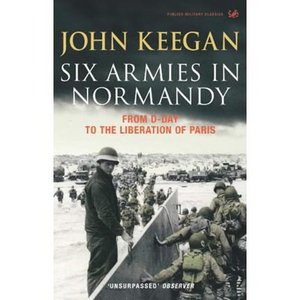
Today is the 68th anniversary off D-Day, the Normandy Landings.  Some time ago I listened to British military historian John Keegan’s masterful Six Armies at Normandy.

Keegan had been a boy during the war and was relocated from London to rural East Anglia.  Although he followed events carefully and with great interest the war only touched his life peripherally – until the Americans arrived.

They came in great numbers, driving machines the likes of which had never been seen in this rural backwater.  They were charming in their friendly openness – a nice counterpoint to the stuffy manners of the local gentry.  GIs would readily toss candy to children – more sugar then most English children were seeing in a month.  He was awed by the bottomless wealth of United States.  He also noted wryly, (this, like all quotes here is inexact and from my memory, as I leant my copy away) “There was something happening in East Anglia about which Mr. Hitler should be deeply concerned.”

And this was only the advance engineering team, constructing temporary quarters.  American soldiers flooded the countryside and then, quite suddenly they were gone.  The next day Keegan remembers waking to the sound of an enormous buzzing.  He looked up and the sky was full of airplanes.  It was June 6, 1944.

In his book, Keegan writes a chapter on the six armies that participated in the Normandy campaign: the Americans, the British, the Canadians, the Poles, the French, and the Germans.  One of his great strengths is shuttling easily between the grand strategic and the small-scale tactical.  He does this particularly well describing the Americans.  Having discussed the enormous resources of the United States and the strategic vision of Eisenhower in masterminding the operation, he then focuses on the American parachutists who landed the night before the main landing.  They were successful beyond anyone’s expectations in sowing confusion in the German rear.  On paper the allies had vast resources, but battles are often truly decided by small units, frightened and far from home, with little to rely upon but their own courage and ingenuity.  Here the American parachutists shone, had they been unsuccessful it is not impossible to imagine the invasion itself would have been a bust.

The Canadians also sent a major contingent to the D-Daylandings, but Canada had inadvertently made a major, albeit bloody,contribution to D-Day almost two years earlier.  Churchill had developed an ill-conceived plan to seize the port of Dieppe.  The primarily Canadian forces pushed directly into fortified German positions and took very heavily casualties.  The read was a complete disaster – and yet – it taught the allies valuable lessons about how to conduct amphibious assaults, while persuading the Germans that the allies would not attempt such an operation again.

Keegan writes respectfully about the Germans, who were primarily Wehrmacht and fought honorably (with a few exceptions.)  This, like the brave Confederate soldiers and their brilliant general of the American Civil War, is yet another iteration of that terrible tragedy – men fighting well for a terrible cause.

Keegan has a particular fondness for the Polish contingent.  Having been defeated twice by the Germans – first in their homeland and then fighting alongside the French in 1940, the remnants of the Polish Army trained hard to become a modern effective fighting force.  They cheered when they learned they were heading into battle, wanting to avenge their nation’s honor.  They got their wish.

In August, with the German 7th Army bottled up,the Polish division was the cork.  The Germans attempted their break out and through a night of desperate, ceaseless fighting, the Poles held their position.  The painful part is that even in their most desperate hours, the Polish division sought news from home.  The Polish resistance had launched a massive uprising against the Germans, hoping for aid from the approaching Red Army.  But the Red Army paused, allowing the Germans to demolish the Polish forces.  Their situation was desperate.  The cities sewers were their lines of communication and men ran into downed aircraft engulfed in flames to retrieve ammunition.

Across France and the Benelux countries is a swath of towns liberated by the Poles.  But they would have to wait another forty-five years for freedom to come to their own country.

Far more men were engaged on the bloody eastern front, where enormous armies of men and machines faced off in massive battle after battle.  But Keegan makes a compelling case that the victory the allies won on D-Day was perhaps the greatest of the war and one of the greatest military achievements of all time.  It was the wealth of France the kept the Nazi war machine running.  The granaries, mines, factories, and people of France all provided the critical supplies needed by the German forces.  When these were effectively moved from one side of the ledger to the other, the Reich could not sustain its war.  Large numbers of young Frenchmen were in hiding, to avoid impressment or work that would support the Nazis.  As France was liberated these men hastily formed a French Army, rejuvenating the allied drive just as the British and Canadian levees were tapped out.

All of this made fascinating reading, but I thrilled just a bit when, during Keegan’s chapter on the British Army on D-Day, he mentioned the Scottish Division.

A Scottish Division was bound to include my favorite Scottish regiment, the Argyll and Sutherland Highlanders.

How does a Jewish kid from Baltimore come to have a favorite Scottish regiment (is he a dork)?  And if anyone is going to have a favorite Scottish regiment, shouldn’t it be the Black Watch?

For answers, tune in tomorrow…

Thursday, May 31, 2012

Do Drone Strikes Increase National Security?

Politico's Arena asked about the politics of Obama's making the ultimate decisions on the "kill list" of terrorists. My answer is here:
There are many sound reasons for President Obama to be personally involved in the decision-making process for targeting individual terrorists.

First, many of these strikes take place in countries in which the United States is not formally engaged in military activities. If the United States were involved in formal military activities tactical decisions could be left to area commanders. But since the status of U.S. operations in places like Yemen and Pakistan is, necessarily ambiguous, it seems appropriate that decision-making occurs at the very top.

Second, it is smart politically. The most vociferous critics of these programs are probably music to Obama as these critics only make him appear more centrist and reinforce his commander-in-chief credentials. Few Americans of any political strike are terribly sympathetic to the terrorists and those most opposed to US counter-terror policies are hardly likely to abandon Obama and vote for Romney.

Finally, it is probably very satisfying personally for the president to run a process where his decision is final. As Richard Neustadt famously noted, the power of the president is most often that of persuasion, rather then command. Most of the challenges the president faces involve endless policy tug-of-wars with congress, special interests, entrenched bureaucrats, and foreign governments. But on targeting terrorists, the president can be the unambiguous commander.

Politically smart, it is an open question however whether or not this aggressive campaign contributes to national security or advances American interests.
I close with a question, let me take a stab at answering it. Two aphorisms come to mind.

When you have a hammer every problem looks like a nail
The drone program is not just a technology, it is a bureaucracy of intelligence gathering and analysis, research and development, and decision-making. Bureaucracies acquire lives of their own and a bureaucracy that can offer distinct, relatively clear results is likely to grow quickly and be used often. All well and good, drones have clearly had a certain efficacy and it appears that the US decision-making process is actually based on the Israeli model.

However, all policies have costs. Drone strikes are easy to use, but they do cause civilian casualties. Apparently unrest in Yemen was triggered by the revelation of civilian casualties caused by drones. Even when these casualties are kept to a minimum, effortless strikes from the sky exacerbate the feelings of humiliation that - in great part - fuel the rage that infects the greater Middle East. This is not to say that drones should not be a tool, only that the possibility that drone strikes are doing more harm then good must be seriously considered.

There are other potential tools of US foreign policy which may do more to mitigate threats. In the case of both Yemen and Pakistan, state breakdown is a very real possibility (current in the former and highly likely within the next decade or so in the latter.) Somalia is already a failed state. But Yemen, with its location and Pakistan with its nukes represent much greater threats to international stability. Preventing terror strikes on the US is important, but these other issues could overshadow the dangers of terror strikes on the US.  Are drones reducing or increasing these dangers?

Is the high-level of American attention on drone strikes crowding out development and capacity building programs that might better serve long-term US strategic interests?  Does the regular use of drones make these programs harder to implement because they decrease the local government's likelihood of working with the United States?

Only Nixon could go to China
A President with stronger national security credentials would be better positioned to consider more complex options, rather then continue to use the simplest and seemingly low cost drone strikes. Because Obama came into office with major questions about his national security credentials, he is more inclined to pursue drone strikes to look tough. A President McCain might not have been as aggressive using drones as he pursued more complex, subtle options. No one would have accused McCain of lacking seriousness or competence on national security matters. Shades of this possibility were seen during the 2008 campaign in which Obama promised to pursue OBL into Pakistan if need be (a promise he kept.). McCain (and really almost any conceivable President) would have done the same, but McCain observed that such statements were not helpful in terms of US-Pakistan relations, which have been exceptionally rocky under Obama.

Finally, the Constitutional issue must be raised. The President has enormous discretion in the use of force and there are sound reasons for this. But at what point are limits placed on it. Or is the Presidential power to kill worldwide now effectively institutionalized?

Tuesday, May 29, 2012

On the VP in Politico & Portman's Complaint

Politico keeps asking VP questions, and like a moth to a flame, I can't resist answering. Here is my answer to the question of whether or not Biden is a PR disaster
Considering the amount politicians are required to speak, it is astounding that there aren't far more verbal missteps by politicians.
True, Biden appears more prone to these gaffes then others, but this is relative. In his 2008 debate with Palin, Biden handled himself masterfully - demonstrating that he was a seasoned, experienced figure - without appearing to bully Palin.
It is a guarantee that every candidate on both tickets will make verbal miscues. Sometimes these mistakes end up shaping a public image as in the unfortunate cases of Sen. Dole in 1976 or Quayle in 1988. Because Biden has a reputation for them, in a sense he is insulated from their fallout.
Chasing Biden this way may be a distraction when the Republicans should be making their case on the issues that will decide this election.
I've written on this before, but considering how much politicians have to speak and the extent to which they are observed it is incredible that there aren't many more gaffes. For that matter, several of Biden's mis-steps in the video in the link above are pretty minor things that could happen to anyone!
Besides, VPs are almost always used in the campaign to rally the base, which often appreciates the mis-steps, remember the Republican base loved Spiro Agnew (even though Nixon couldn't stand him.)

Portman's ComplaintAs long as we are talking Veep, the Washington Post has a big article on VP potential of Ohio Sen. Rob Portman. Based on resume, Portman is a great fit for Romney as governing partner. He has been a White House staffer, congressman, US Trade Representative, OMB chief, and now Senator. Romney will need someone who knows DC and Portman fits the bill. The article made him sound even better, noting that Portman played the opponent when Cheney and Bush prepped for their debates. He did a good job, studying hard and helping the candidates anticipate the other guy's tactics. Presidents don't necessarily need another strategist or policy advisor, they need someone who has a strong sense of exactly what they are dealing with and can help them deal with it. As mentioned above, a minor mistake can become media fodder for weeks and a real distraction. Another politician can help see things that a staffer or policy wonk might not.
The problem with Portman is that he is considered boring. This gets into how we grossly caricature our politicians (as discussed above). Politicians must be charming and likable to be effective at all. The ones who are described as boring might still be the most impressive people most of us would ever meet. Remember, the worst hitter in the major leagues was a star of his high school team and would lead a typical company softball team to victory after victory.

Cross-posted from Veepcritique

- Posted using BlogPress from my iPad

Tuesday, May 22, 2012

Debating Propriety of Yelling "Oh" during the Star-Spangled Banner

Washington Post sports columnist Mike Wise recently criticized the Baltimore custom of shouting "OH" during the National Anthem at ballgames:
Orioles fans are not alone in their desecration of “The Star-Spangled Banner,” of course. Many of their tainted gene pool have migrated to Verizon Center for Capitals games. Some of these louts actually yell “OH!” and “RED!” at different intervals — twice ruining the anthem. Their spawn can be found in Houston, too, where a small group called “The Red Rowdies” holler “ROCK-ETS RED GLARE!” during Rockets NBA games. And they wonder why Tracy McGrady never won a playoff series.

Here’s wishing famine and pestilence comes to all their tailgates.

Allow me one serious, high-horse moment: Look, you’re not unpatriotic if you yell “OH!” It doesn’t make you an awful American. But by claiming the lyrics, if only for a moment, you fundamentally undermine the idea that the song was written to unite instead of divide. A national anthem is a national anthem, not a convenient vehicle for one’s immense pride in his or her team.
As a Baltimore native, I took umbrage with this dismissal of a tradition rooted in history and The Washington Post, to its eternal credit published my response:
Mike Wise argued that the tradition of Orioles fans shouting “Oh” during the national anthem at ball games taints a moment of patriotic unity with parochial fandom. Further, he lamented that the fans of other teams have begun to adopt similar practices. On the second point, Mr. Wise’s argument has much merit. But it is entirely appropriate for Baltimore fans to adapt “The Star-Spangled Banner.”

An also-ran among the great cities of the eastern seaboard, Baltimore (my place of birth) is a modest, homely and provincial city. But, in September 1814, with Washington smoldering and the United States itself in peril, Baltimore fought off the British and upheld the nation’s honor, inspiring Francis Scott Key to pen “The Star-Spangled Banner.”

The national anthem should be a source of unity, and the rest of the nation should also join in saluting this Baltimore custom in deference to the service of that otherwise humble city.
It is worth adding that it really was the city of Baltimore that repelled the British. Fort McHenry was built by the citizens of Baltimore. James McHenry, for whom the fort is named, was a former Secretary of War who spearheaded the fundraising drive. When they learned the British were coming, citizens of Baltimore built makeshift fortifications to defend their city and the soldiers manning Fort McHenry were, for the most part, local militia.

I’ve written about Fort McHenry, which has a long and fascinating history post-War of 1812 before, it is an especially nice place to spend Memorial Day and even better with kids.

I hope my enthusiasm rubs off, I am kind of a dork about visiting forts – I even love to visit the ruins of forts, which abound in the DC area.