Monday, August 24, 2020

Data is the Story

In middle school English I remember we did a drama activity in which the class divided into groups. Each group wrote, produced, and performed a play. The point of the activity was that each part of the process – the writers, the actors, and the stage crew/promoters etc. was important to putting on a good play. I got it and when I talk to my friends in Hollywood, many of whom work on production (although I know a few writers as well) they emphasize how critical the sound engineer’s work (for example) is to making a decent movie. Conversely a bad sound engineer or video editor can absolutely ruin a movie. Many of these functions will go unnoticed – a prop-master has done a good job if the viewer never even thinks about the props because that they fit seamlessly into the story. 

All well and good, but I didn’t buy it: because without a writer, you have nothing. Seeing a tremendous production of a Shakespeare play is a sublime experience. But reading a Shakespeare play is pretty great in and of itself. The same cannot be said about the other components of the play (or movie.) The writing is the engine, the essential thing.

Go figure that I aspired to be a writer…


Now, in my data analytics adjacent professional world, this lesson has returned to me. AI/ML is all the rage these days. Yet, high-end analytics are useless without data. At the same time, with data, even simple analytics can be extremely useful and provide important insights. Mapping to the drama comparison: the data is the script, the analytics is the acting, and production is everything else – visualization, communication etc.


Analytics can play a critical role in bringing meaning from the data. Visualization and communication (the latter is my part of the business) are critical for making the findings interpretable to decision-makers and meaningful to the public. The importance of both of these elements should not be underplayed. But without data, there is nothing. I’ve been to meetings where potential users get very excited over a flashy visualization, not recognizing the dearth of substance beneath it.


To people outside of this world, it should be understood that in many cases, the data on a particular issue or problem is not collected or is not collected consistently. There are a range of social and policy issues around this. We are seeing it now in the pandemic response, where data on COVID-19 cases is collected inconsistently. There are divergences in timing, delivery, data format, and a plethora of issues that complicate obtaining an accurate read on the national situation.


Caveat: This is not to fuel conspiracy theories that COVID-19 isn’t a big deal. It is. The data we have is imperfect but undeniable – millions have been infected and over 170,000 people have died, most needlessly. The point is more accurate data would enable more effective policy response: identifying points of origin, trajectory of spread, and more accurate projections of future outbreaks.


In many cases, what is called algorithmic bias is really a matter of data bias. The data was collected improperly or annotated and curated improperly. This is a vast issue. The way data is collected reflects institutional priorities and the way in which instances are categorized as types shapes what kinds of analytics can be run. Bad analytics can generate lousy findings from good data, just as a lousy actor can ruin a great scene. Glossy visualizations and smooth patter can sell weak conclusions (who hasn’t gone to a lousy movie because of a great looking trailer.) But if you don’t start with good data – that as much as possible reflects reality and takes into account the multiple facets of reality – you are unlikely to end up with quality results.


This is hard to do, just like writing is hard: I complain about it constantly. But good writing and good data both share a quality of the real and can unlock deep truths.

Tuesday, August 11, 2020

Advice for Joe Biden's 2020 running mate in USA Today

USA TODAY OPINION

'The vice presidency is a good gig': Here's some advice for Joe Biden's 2020 running mate


Aaron Mannes, Opinion contributor Published 5:02 a.m. ET Aug. 2, 2020

https://www.usatoday.com/story/opinion/2020/08/02/biden-vice-president-running-mate-history-advice-column/5547954002/

You didn’t become vice president just for future opportunities. You want to make a difference now. There’s good news and bad news.

Congratulations on being selected as Joe Biden’s running mate. If the polls hold, you’ll be the first female vice president of the United States. (Don’t take too much credit for the win, or blame if you lose. Research shows that the vice presidential candidate doesn’t make much difference.)

The vice presidency is a good gig. It comes with a plane, a nice house and lots of high-profile appearances. It provides a good chance of becoming president. Of the 48 vice presidents, 14 have become president (15, if Biden is elected). Again, if Biden is elected then in the past 14 presidential elections, three vice presidents have been elected president (Nixon, Bush and Biden) and two others came very close (Humphrey and Gore).

But you didn’t become vice president just for future opportunities. You want to make a difference now. There’s good news and bad news. Good news, first.

Good news for the potential next VP

In 1976, Democratic presidential nominee Jimmy Carter revolutionized the vice presidency. Historically, the office was mostly the butt of jokes, what historian Arthur Schlesinger, Jr. called a constitutional "appendix.” Carter viewed this as waste. The former Georgia governor chose Walter Mondale, a respected Democratic senator from Minnesota, for their personal and political compatibility. This was an innovation in its own right — previous presidential nominees hadn’t given it much thought. Carter ensured his vice president would have access to the president and the White House policy process. This included a weekly private lunch with the president and entrée for the vice president and his staff to White House meetings and paper flow at every level. Most important was giving Mondale a West Wing office. In the White House things happen on the fly, but unlike his predecessors, Mondale could look in on the national security adviser or chief of staff — whose offices are right next door, or see the president in the Oval Office down the hall.

These vice presidential perquisites have continued and expanded. Mondale’s chief of staff was also made a member of the White House staff, giving him access to the White House. By 2016, the final full year of Biden’s vice presidency under President Barack Obama, eight people from his office were also on the White House staff.

Biden, as a two-term vice president, chose you for the ticket because you are “simpatico.” Biden won’t cut you out of the process, like President Richard Nixon did to Vice President Spiro Agnew, who he despised. You will see the president often and know what’s going on in the White House.

There’s stuff you should do to keep things this way. Presidents hate leaks. You can give the president unvarnished advice, even disagree with him, but do it privately. Stories of president-vice president disagreements will be bad for both of you. Don’t let your staff leak either. Dan Quayle didn’t have a great hand to play as vice president in President George H.W. Bush’s administration, but his staffers leaking White House dirt didn’t help. And when the president makes a decision, like it or not, publicly support it.

Bad news for Biden's VP candidate

Now the bad news: Biden knows how to “president.” The expansion of the vice president’s role has coincided with a string of outsider presidents who came to office with little or no experience in D.C.—governors (and also Obama who had only been in the Senate for four years). They turned to their vice presidents when they faced new issues such as national security, and unfamiliar Washington institutions, like Congress.

Biden was vice president for eight years and a senator from Delaware for 36 years. What can you tell him about Congress or world affairs that he won’t already know? Further, Biden has plenty of experienced advisers. Outsider presidents have turned to the experienced staffers of their insider vice presidents. When incoming President Ronald Reagan saw his team needed more Washington experience, he turned to James Baker, campaign manager and close friend of his GOP primary rival-turned-vice president, George H.W. Bush. As White House Chief of Staff the uber-effective Baker played a critical role in making the Reagan Revolution a reality. 

Serving an insider president puts you in a similar position to Dan Quayle, who found the job mostly fundraising and funerals.

All is not hopeless. One presidential resource is finite: time. Find areas that are important, but the president lacks the time to address. Quayle did useful diplomacy in Latin America and Asia, where the president’s national security team — focused on Europe and the Middle East — didn’t have time. Alternately, the president may have an issue in which he is heavily invested and assigns you to reinforce this commitment. President Bill Clinton was deeply interested in Russia and assigned Vice President Al Gore to oversee a bilateral commission to strengthen those ties. 

Unattached to any bureaucracy and with a unique convening power, vice presidents can be a force multiplier and bring focus to key issues. George H.W. Bush oversaw regulatory reform and a counter-terror task force. Besides several bilateral commissions, Gore ran the reinventing government initiative. Biden managed the stimulus spending for Obama. Biden will probably give you a few such assignments. 

Biden is famously friendly, you’ll get along great with him. But that doesn’t mean that your efforts mesh politically with the White House, which is a big bureaucracy in its own right. Having some of your staffers in senior White House positions would be great, but unlikely. Encourage your staff to get close to their White House counterparts, and consider bringing experienced Biden staffers onto your team.

Your job is to help the president any way that you can. Everything you know about the president — what he’s worried about, what he needs, what he doesn’t know that he should — can help you help him.

Congratulations and good luck. We all are wishing you every success — we’re all counting on you.

Aaron Mannes is a lecturer at the University of Maryland School of Public Policy. He wrote his dissertation on vice presidential influence. Follow him on Twitter: @awmannes

Sunday, July 5, 2020

Independence Day: The Morning After

We hold these truths to be self-evident, that all men are created equal, that they are endowed by their Creator with certain unalienable Rights, that among these are Life, Liberty and the pursuit of Happiness.--That to secure these rights, Governments are instituted among Men, deriving their just powers from the consent of the governed, --That whenever any Form of Government becomes destructive of these ends, it is the Right of the People to alter or to abolish it, and to institute new Government, laying its foundation on such principles and organizing its powers in such form, as to them shall seem most likely to effect their Safety and Happiness.

Yesterday we celebrated Independence Day. Today we woke up to a complicated, messy reality. The ideals of the United States of America, so eloquently expressed in the Declaration of Independence, are inspiring. But we see, almost constantly, how we fail to live up to them. The national failure of COVID-19 has exposed so many ways in which the United States is failing to secure the inalienable rights of the American people. From poor public health infrastructure to the weakened social safety net – the rest of the economically developed world has managed the pandemic (at high cost to be sure) and is ready to go back to business. The United States is wallowing in an ongoing and at least to some extent avoidable crisis.

There are other failures, beyond those linked to COVID-19. The criminal justice system, institutional racism and sexism, and the way in which the financial industry preys upon those who have the least are just a few of the issues highlighted in recent years.

We are in an era of what Samuel Huntington called Creedal Passion in which the American people seek to bring American reality into alignment with our core values – our Creed. These are periods of enormous ferment and tumult – like the Sixties or the Progressive Era. In such times, the nation’s history comes under scrutiny. 

We have never lived up to our values. Building the United States involved massive crimes against the Native Americans, the slavery of African-Americans, and other terrible depredations.  Reputed golden ages – such as the Fifties were built on systematic repression of African-Americans, women were constrained in their choices, while corporations were able to harm the environment and consumers with limited oversight.

But this bleak view is not completely fair. Our values are not just a sham. We do in fact strive for them. It took too long, but slavery was destroyed. It took too long, but women received the right vote. The United States has accepted immigrants from around the world and allowed them to enjoy life, liberty, and the pursuit of happiness in a way they could not in their nation of origin.

I have a personal stake in this. My people were at the bottom rung of the latter across Europe for over a millennium. Here in the United States we have prospered, been accepted, and have been safe in a way unprecedented in our long history.  I love this country for what it has meant for me, my family, and so very many. I want all Americans (and ultimately all people) to enjoy their inalienable rights.

There is much to be done.

Sunday, August 11, 2019

A Note of Hope on Anti-Semitism in America

Today is Tisha B'Av, the saddest day in the Jewish year. It is the day we remember the destruction of the ancient temples. It is a day of mourning, fasting, and contemplation. As it ends however, it turns to a message of hope, that what was lost will be rebuilt and renewed.

As it is nearly over, let me offer a message of hope.

I too am horrified by the seemingly endless cycle of massacres, and sadly, American Jews have been an all too frequent target. The massacre at the Pittsburgh synagogue was the deadliest attack on Jews in American history and has since been followed by shootings at synagogues in San Diego and Miami.

Where's the hope?

At synagogue, after one of these incidents, the rabbi asked for thoughts. When the room was silent, I offered this:
None of us have any illusions that anti-Semites are out there and want our blood. But they are a fringe. Unlike so many times in our history, there are no mobs gathering the streets calling for our blood. And the government is not complicit, it is absolutely opposed. When anti-Semitic incidents occur, does anyone doubt that the police are committed to protecting us? When an incident occurred here, and the FBI became involved, was there any question that they were not investigating diligently? When incidents occur, do our neighbors say - like they may have said in Germany or Poland (where our ancestors fled) - "Well, Jews, what can you expect?"
The answer is: No. I am sad that we have felt the need to hire a policeman to sit outside our synagogue on Shabbat. But I do not doubt that he will do his uttermost to protect us. If something did happen, our neighbors, of every faith or none would be here to support us. Our political leaders would condemn it vehemently.
I am horrified by the violence, like all of you, but I am still heartened, that in this country, we are not alone.
That is my message of hope. For those observing, I hope you had a meaningful fast.


Wednesday, October 24, 2018

Political Violence in an Age of Creedal Passion

My regular readers and pretty much everyone I talk to knows that I am trying to write about some deep cycles in U.S. history that are shaping our current political environment. I want it to be a book, and am writing academic papers for various conferences in an effort to make it happen.

To that end, I submitted a paper entitled Political Violence in an Age of Creedal Passion to the Southern Political Science Association. The abstract is as follows:
This paper will explore patterns of political violence during periods of Creedal Passion, and how this type of violence might manifest in the coming decade. In “American Politics: The Promise of Disharmony,” Samuel Huntington identified the second and third decades of the 21st century as a period of Creedal Passion in which the American people seek to bridge the gap between their institutions and their ideals. The previous periods of Creedal Passion include the American Revolution, the Jacksonian Era, and the Progressive Era, and most recently the Sixties and Seventies. The present day evinces the characteristics of these eras including public opposition to hierarchies and concentrations, questioning traditional sources of authority, and a focus on long-standing sources of social inequality.
Each of these eras was accompanied by significant political violence, from the outright revolt against British rule, to the rioting during the Jacksonian Era, the anarchists of the Progressive Era, and the leftist extremism that accompanied the Sixties and Seventies. These eras were not necessarily more violent than other epochs in U.S. history, however the political violence was a manifestation of Creedal Passion. This paper will examine each of these eras and to understand how political violence emerged from and interacted with the broader reform movements and with society at large during eras of Creedal Passion. The paper will then apply these insights to better understand political violence in the United State today.
There has been significant violence in our current era of Creedal Passion already. Much has been on the political right, although there have been notable incidents of political violence on the left as well. There have also been a proliferation of just strange events like the Comet Pizza attack. This was not, strictly speaking, a political event (although it was linked to outrageous political rumors). But it reflects the general discontent and energy that characterizes eras of Creedal Passion.

The attempted bombings of former presidents and other politicians is something new. Eras of Creedal Passion have, sadly, featured assassinations of political leaders. The first assassination attempt on a president was against Andrew Jackson. The man was mentally ill, but again, there was a madness in the air as well. The Jacksonian Era also saw the sudden rise of the anti-Masonic party, after Masons murdered a man who threatened to reveal their secret rites.

Eternal Flame at JFK's Grave, photo by Tim Evanson
In the Progressive Era, William McKinley was assassinated and Theodore Roosevelt was only saved by his extremely long speech folded in his pocket. The Sixties saw a string of assassinations: JFK, RFK, and Martin Luther King.

It is worth remembering and putting things into perspective on this awful day. In the 1960s massive urban riots swept through American cities. In the Progressive Era, violent bloody confrontations between labor and business. We aren't there - and I don't think we'll get there. But sadly, things will get crazier. I'm trying to figure out how.

UPDATES: Events keep overtaking me. Now, we have the horrific news from Pittsburgh, where a monster with a gun committed the worst act of anti-Semitism in U.S. history. I love this country, it has been amazing for the Jewish people (my people!) I am heartsick, but I am also heartened that the people of Pittsburgh - and almost everyone - are rallying around their neighbors.

I would also say that both in responding to the bombings and the synagogue shootings, our law enforcement agencies have acted with utter professionalism. There is still a commitment to rule of law in this country.

I ended the initial post (above) saying things are not as bad as they were in previous eras of Creedal Passion - but that the madness we are in is nowhere near over. I stand by that.

I don't have any hot-takes, but I'll make this observation. At some point some forms of serious gun control will be passed. The NRA has been winning battles for a very long time. Eventually it will lose - possibly soon. This will be to the good. There is simply no way to ignore the simple reality that access to firearms enables individuals and small groups to do absolutely terrible things.

However, the forces of Creedal Passion cut in many different directions - it is not simply left or right. For some Americans gun control threatens a sacred right. Most gun owners are law abiding, and they may grumble, but they will obey the law. For some however this gun control will be an enormous offense and lead them to more radical positions - and yes - to violence.

The only way out of this is through.

Monday, October 22, 2018

Could Saudi Arabia Collapse?

I used to do Middle East. Not so much anymore. I haven't followed the ins and outs of the Saudi royals either. That's its own real world. If you are interested, I can send you pointers to people who know this stuff well.

But, I do know this: every single Arab country, without exception, is built on sand. I don't mean this literally (although it seems true in many cases.) Rather, I mean that the societies are fragile, they are run by unpopular dictators, and their economies do not meet the needs of their people. All of these states (as we saw in the Arab Spring) were dry tinder waiting for a match.

I write this thinking that we need to consider seriously that the Jamal Kashoggi affair could bring down the Saudi government and replace it with a terrible civil war. The Saudis themselves are clearly concerned about this.

Smart Middle East hands, who may not like the Saudis much, will probably say we use this carefully push them towards reform - but we don't want to dump them. They are valuable allies (if morally dubious ones, but hey, welcome to the Middle East.) I don't like the Saudis much either. But, this is probably the smart play.

Putting aside this administration's competence to pull of the smart play, things can get out of hand. The opprobrium heading towards the Saudis can set a serious set of cascading events into motion. The Saudi regime cannot take care of itself. It relies heavily on foreign technical support. What happens when no one wants to provide that support because of public pressure? When the Saudi people lose confidence in their corrupt dictatorial regime, they are done for.

I'm not saying that this WILL happen. They've weathered a lot so far. But right now, nothing is impossible.

Syria, The Night Watch by Briton Riviere (1840-1920), painted in 1880. A favorite of mine at the wonderful Walters Art Museum in Baltimore.

Tuesday, September 18, 2018

Listening to Women, Learning Empathy

Somehow this Rothko captures the mood.
I am not writing this to advertise myself as some wonderful "woke" guy who really gets all of the indignities and awfulness that women suffer. My hope here is to share my path to at least a glimmer of empathy in the hope that it will help and inform other well-meaning men and boys to also be understanding and better.

So I'm writing about me, but it isn't about me, I'm just trying to set the stage.

First, two decades ago, when the Monica Lewinsky scandal was the big news I worked in a small office with two women. When we began discussing current affairs I made the argument that perhaps Ms. Lewinsky was just a tiny bit responsible for what had happened.

My colleagues rounded on me. They adamantly stated that this was a situation between a powerful man and a powerless woman, it was not her fault. I dropped my argument because a light went off in my head - both of my colleagues had been in a comparable situation!

And if that were true, it means that many - most - women have also been in a comparable situation. This meant that most women had been ensnared in a fraught, sexualized, if not sexual, relationship with a more powerful man.

This is on top of the constant  harassment and judgment to which women are also subject. I haven't surveyed women I know to find out how true this is. But between listening to my wife and just paying attention - it's pretty clear how pervasive these situations are. Women worry about situations to which I would not give a second thought (such as whether an Uber ride in a strange city could become an assault.)

This was the beginning of a great sympathy towards women. I don't think I was ever a bad guy, I was nice and courteous. But this first realization helped me develop a sense of compassion about what women have to go through - but not empathy, I couldn't claim to truly grasp their experience.

Now, with the questions around Kavanaugh's behavior - his alleged attempted rape - my sympathy has deepened. Reading Caitlin Flanagan's article on a similar incident that happened to her as a teenager is a reminder that huge numbers of women have had a similar experience of physical assault. Even more women were in bad situations that could have become an assault, but that they somehow evaded. Let's be very clear, that still leaves a scar. The fact that rape or assault did not occur does not mean that nothing happened or that the experience was not terrible and frightening.

Anyone who thinks that the outpouring of women supporting Dr. Ford is cynical politics is fooling themselves. They believe her because they have been there.

A Mile in Another's Shoes
Sympathy is generally understood as compassion towards, while empathy is understanding another's situation - putting yourself in their shoes. Empathy is harder. Science fiction writer Jonathan Scalzi, in an epic blog post wrote that if life were a video game: "'Straight White Male is the lowest difficulty setting there is."
This means that the default behaviors for almost all the non-player characters in the game are easier on you than they would be otherwise. The default barriers for completions of quests are lower. Your leveling-up thresholds come more quickly. You automatically gain entry to some parts of the map that others have to work for. The game is easier to play, automatically, and when you need help, by default it’s easier to get.
This straight white male does not always understand what those unlike myself have to go through. But I'm trying. To show how I got there, I need to talk about myself a little.

A Glimmer of Empathy
When I was a kid I was bullied, a lot. I was an awkward, strange, nerdy kid. This happened at school, in my neighborhood, (oddly) at Hebrew school, even at (can you imagine) a summer program for gifted and talented kids. That's right, I was so nerdy that other nerds picked on me. I was insulted and taunted. I was pushed around.

I was never really beaten up. I took steps to get out when the situation got threatening. It was often humiliating. But I was weak and uncoordinated. Attempts at violence were not going to go well for me. On TV, the victim slugs the bully in the face. And it turns out the bully was just a coward. Maybe so, but I'm not sure it would have worked out so well. In my experience, the bully was just looking for an excuse. Also, lots of times the bully had a bunch of friends. There was no honor, they would have piled on and beaten the crap out of me.

I have a great life now. None of this should matter. But I can still get mad about these incidents from three or four decades ago - in an instant. I still wake up at night with elaborate revenge fantasies.

But this is not about me. 

What I dealt with was chump change, small potatoes compared to an attempted rape. Thinking about my own open wound, made me realize just how massive the hurt that must be left by a sexual assault.

I don't want to equate my being pushed around at the playground with an attempted rape. It is not, not even close.

Update - A wise friend wrote to me:
I'd add here a caution of false equivalency. You left the playground/summer school--women must be vigilant wherever they are, every moment of their lives. The threat never stops. One is a fixed incident in time and space and the other is persistent through time and space. 
So if I consider my still festering anger and pain, and then try to imagine it extended many orders of magnitude into multiple dimensions, then maybe I have glimpsed just a shadow of what most women are carrying with them. The fact that despite these deep wounds, women carry on - raise kids, work jobs, write articles and PhD dissertations - is simply amazing.

That is the beginning of empathy.

Try it and extend it to everyone - people of color, LGBTQ, and the disabled.

Sunday, July 22, 2018

Tisha B'Av and the Ruins of Rome


As Tisha B'Av winds down, my thoughts return to my recent visit to Rome (and food, Tisha B'Av is a fast day and I'm really hungry.)

I've been meaning to write up my visit, it was wonderful. I saw splendid things, met interesting people, tasted delicious food, and had lots of gelato. But, in the spirit of the day - which is the saddest day in the Jewish calendar, remembering the destruction of the ancient Temple by the Babylonians AND the Romans - this will be more somber. It will expand on my Tisha B'Av post from two years ago.

I love ancient ruins. As a graduate of St. John's College and a general fan of history, antiquity fascinates me. Yet, my visit to the great ruins of Rome, centered around the Forum, was delayed until nearly the end of my trip. Between meetings and tours I had booked, my time with the ruins was limited to my last afternoon. And I took a nap. Still, the Forum is open late, until 730, so when I got up in mid-afternoon I had plenty of time.

The ruins of Rome have a particular fascination for me, because I play a game called Caesar. It is a city-building game - like Sim City - but set in ancient Rome. So I know a bit about Roman architecture and urban development. As I wandered around the city I hummed the music from the game. (FYI - I haven't played the game in years, the ancient laptop I used for it was stolen.)

Circus Maximus!
I had earlier visited the City of Water, a lesser known archaeological site (Rome is crawling with them) in which construction had discovered an an insula (a tenement) that was rebuilt in the 4th century as a luxurious domus. This is exactly what happened in Caesar!!!

Later a walked along the Circus Maximus, the site of the great chariot races. Now it is a big empty field, but in the game, if you built one you were pretty close to winning the game!

A Funny Thing Happened at the Forum
I set off the for Forum, excited thinking I had saved the best for last. But, after stops for gelato and quick looks at the many other ruins, when I arrived at the Forum they were still open but not providing the audioguide. The Forum was closing "soon." The official close time was still hours away...

I downloaded a different audioguide and began exploring. But when I went in one direction I was instructed it was closed as the Forum would be closing soon. I got perturbed, started walking, and found myself on Palatine Hill.

The Forum was the heart of ancient Rome, while Palatine Hill overlooks it. It was the seat of the Imperial Palace. Admission to one grants admission to the other, but once one site is exited, you cannot re-enter it.

Ruins on Palatine Hill
Hints of past glories
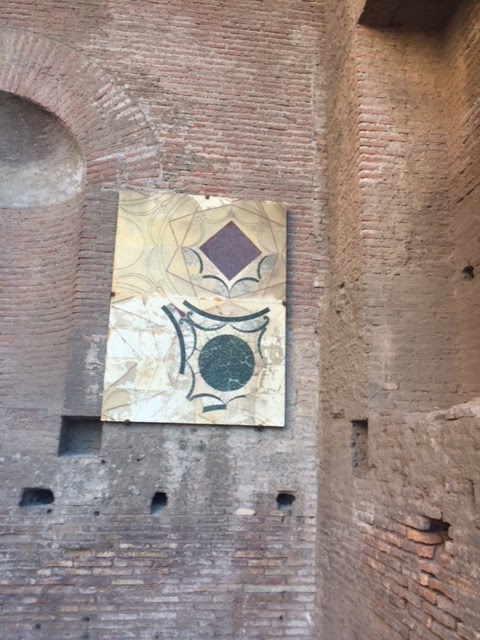
So I explored Palatine Hill. It was mostly remains of brick walls - with terrific views of Rome, the Forum, and the nearby Colosseum. The scale of the Imperial ruins are impressive, but there are only the faintest hints of its past grandeur. A piece of marble column here and a fragment of a mosaic there.

The Forum - seen from Palatine Hill
Somewhere around 630-645 (well before 730) I was definitively shooed out. On exiting the site, one comes to the Arch of Titus. Built to commemorate the Emperor Titus' conquest of ancient Palestine it include the image of the Great Menorah from the Holy Temple in Jerusalem being paraded through the streets of Rome. This sacred relic was reduced to war booty.

The Colosseum: A Temple to Cruelty
Just beyond the Forum was the Colosseum. It is a remarkable building. It was closed but I walked around outside. I was a touch disappointed from not really getting to see the Forum. I learned that Titus had build the Colosseum with the spoils taken from Jerusalem. The gladiatorial games in which people fought one another or killed animals are abhorrent to Judaism (and to me).

It brought the day into perspective. Palatine Hill made sense. The palace of the most powerful man in the classical world was, in mere centuries, reduced to piles of bricks. Rome became a swampy backwater for centuries. Yet we - the Jewish people - are still here. This is not celebratory. I am not glad Rome fell, I do not revel in the sufferings of others. Rather it is a reminder of the vast tides of time and history, and of those things that truly keep us afloat.

The Great Menorah depicted on the Arch of Titus - the Jewish people proved to be more than our things

Monday, May 28, 2018

Memorial Day Thoughts: No New Civil War

Suddenly everyone on them Twitters is talking about a coming civil war, based primarily on this expert assessment that is umm... meaningless.

Memorial Day was, of course, started to honor the dead of the Civil War. It was established in great part due to the efforts of John Logan, a truly great American. He was a citizen-soldier, a war hero, and an accomplished politician. He founded the Grand Army of the Republic, a veterans group, after the Civil War and as a politician tirelessly advocated for the rights for freed slaves. I work near Logan Circle, where his Washington home stands and where there is an impressive monument to him. (He also ran for vice president.)

The deaths in the Civil War are hard for us to comprehend. Fully half of all of the Americans killed in war where in that conflict. Over 600,000 Americans died, from a population base one-tenth of todays. A new Civil War on such a scale would take six million lives. It would bring unfathomable horrors.

It was faced with the aftermath of these enormous losses, that Memorial Day (originally Decoration Day) was established.

We are nowhere near this. Not even close. (There are political scientists who specialize in Civil War who could, undoubtedly explain through comparative analysis why the U.S. is not heading into Civil War.)

The Civil War occurred because there was a massive, unconscionable crime that was irreconcilable with the core values of the American people. There were also powerful vested interests that would not compromise on the issue. The economy of the South relied on slavery - at least for the region's elites.

Things feel and in many ways are awful now. But not Civil War awful. This is not to lessen the cruelties that are currently pervasive in our society. The monstrous policies towards migrants, the continuing institutional racism, and the growing income inequality leading to mass immiseration. But how is a Civil War appropriate or necessary to rectify this? Against and between whom?

One of the things that spurred this talk of Civil War was the August 2017 neo-Nazi rally in Charlottesville, VA. It was, of course, distressing and terrible to see Nazis marching in mass and the president's mealy mouthed response only contributed to the feeling that our nation might break. But what has happened since? Many alt-right groups - under law enforcement pressure - began to implode and their leader is now begging for funds - without much success. 

None of this is to say that things are going swimmingly in these here United States. By all means we should exert every effort to try to right ourselves as a nation. But the clear and vast injustice simply does not exist.

Political Violence in a Period of Creedal Passion
Interestingly, the original post that sparked this conversation specifically said, that they weren't really thinking about a full on war. The post author wrote:
Definition: By “civil war,” I don’t necessarily mean set-piece battles and Pickett’s Charge. I do mean widespread political violence with parallel (though not necessarily connected) efforts to reject current political authority in certain legal domains or physical spaces.
That is another story entirely and yes, that is going to happen. We are in a period of creedal passion, in which we try to remake ourselves in line with out values. Outlined by Samuel Huntington, periods of Creedal Passion are characterized by broad questioning of authority, in which privilege and hierarchy comes under attack, and even potential violation of norms comes under attack.

The last round was the 1960s, which had a bit of political violence.

There are numerous communities within the U.S. which feel that the nation is headed the wrong way and might turn to violence. We've seen it from the "alt-right" and there is certainly potential from the truly massive sovereign citizens movement. I would not discount the potential of violence from other vectors as well. The emotions stirred up in periods of creedal passion are powerful, and when that happens the disturbed radicals may feel that the wind is at their back.

Also, I believe that new gun control measures are coming. The NRA has won politically for a long time. But nothing is permanent. When those measures come, the vast majority of American gun owners will accept them. A few won't.

None of this is a true Civil War, and frankly all of this violence in total will be a fraction of the appalling level of criminal violence our society already tolerates. But of course political violence, particularly if it has a spectacular element, has a way of resonating in the public imagination.

And therein lies the danger, not of secession. But rather that low-level violence further degrades trust, perhaps on a scale that it cannot be repaired.

Perhaps in the context Memorial Day is more important than ever as we focus on our deepest beliefs and how much so many have sacrificed for them.

Update: I just want to clarify this civil war thing. What if President Donny Two-Scoops is impeached. What then? Could that trigger a civil war? Seriously, Alabama (yea, I'm talking to you) would you secede for this guy? Would that make sense? 

I remember during the 2000 election imbroglio reading the Egyptian press. They were convinced the U.S. was on the verge of a Civil War. But really, who would strap on weapons for Al Gore or George W. Bush. I think now is the same.

Political violence, sadly, yes. Civil war, no.

Wednesday, May 2, 2018

Technology, Risk and Facebook's Dating Service

Facebook, thanks for providing the perfect demonstration of my recent paper on risk communication and technology, presented at WeRobot2018. In starting a new dating service, Facebook shows exactly the cluelessness that I worried tech world had about public attitudes.

Full disclosure, I really like Facebook. I enjoy it immensely and there is a decent chance readers will find this post through Facebook. Further, on the whole I am a fan of new technology, we've seen great things happen in recent decades. My paper is a bit of a cri de coeur to tech world urging them to consider public perceptions so that when they do something ill-advised they don't face backlash that stymies innovation.

Let me start from the beginning.

Communicating Risk
Robots, that is, in the words of the inestimable Laurel Riek, are: physically embodied systems capable of enacting physical change in the world. This change, either locomotion or manipulation, means this systems will be able to do harm. The paper includes an in-depth taxonomy of vectors of harm robots may do. Further, many, although not all, robots are directed by non-deterministic algorithms, which means that they may act in unpredictable ways. (The tragic Uber self-driving vehicle accident is an example.) On the whole, these systems have enormous potential to bring benefits, but that must be balanced against the potential for harm.

To make informed decisions about using and interacting with robots, people need essential information. Ensuring people have this information is the role of risk communication.

The paper begins with a summary of risk communication, a well developed field. There has been extensive research on risk communication and public health and environmental issues, as well as the subfield of crisis communications. There has been extensive research about how to best communicate probabilities, what type of language to use, and what mechanisms are most effective for reaching audiences. This is not to say it is a settled science, much of the work is intuitive and every issue and situation will require new approaches.

Further - and this is big - people vastly overestimate how well they understand others and how well they are understood. This, from my cursory reading, is central to communications theory and makes all of this really hard. A communicator might think they did a bang-up job, but the key points recalled by the recipient were not what was intended.

The obvious conclusion is that the robotics industry should start studying this field and figure out how to apply it. But there's more (and I'm coming back to Facebook - even though they aren't building robots.)

Risk Perception
But there's more. A lot more. The risk communication process described above is a rational cost benefit analysis process. But that is not how people make decisions. Certain types of risks and benefits loom large in people's minds out of proportion to their probability. The classic case is terrorism, which your TerrorWonk will readily point out is much less likely to kill someone in the U.S. than a car accident. But this offers little comfort, people understand car accidents and feel they have some control. Terrorism is poorly understood, uncontrolled, and potentially catastrophic. Terrorism, in particular, inspires dread because there is an active adversary behind it.

It would be easy to dismiss these concerns as irrational, but also unwise. Paul Slovic, one of the giants of this field, wrote:
Perhaps the most important message from this research is that there is wisdom as well as error in public attitudes and perceptions. Lay people sometimes lack certain information about hazards. However, their basic conceptualizations of risk is much richer than that of experts and reflects legitimate concerns that are typically omitted from expert risk assessments.
Donald MacGregor, of MacGregor-Bates Applied Decision Concepts, put it more bluntly, telling me:
Familiarity with the technical risk analysis can breed contempt for those who don't share the same views of risk. 
This is where businesses, industries, and governments can get into trouble, when they do not consider these perceptions of risk a failure can lead to a "signal" event that triggers public concern of catastrophic impact. The classic case is the nuclear power industry. They did not consider seriously the potential of an accident, did not engage in serious risk communication, and when Three Mile Island occurred the public was frightened. Even though the accident did no real damage, the public perception shifted quickly and nuclear power development was effectively halted in the United States.

In the paper I discussed how robots, because they are perceived as having agency and because their actions may not be well understood may trigger high levels of perceived risk and could trigger a signal event. I'll go farther and say that tech world more broadly is not immune to this possibility.

A Matter of Trust
Effective risk communication relies on trust. If the communicator has trust, the audiences will hear their message and bear some risks. Trust however is very hard to build, requiring extensive two-way communication. It is also very, very easy to lose.

My concern is that tech world is assuming a high level of public trust. Facebook (remember them) has the famous slogan: move fast and break things.

Former Google CEO Eric Schmidt told an audience at MIT: Instead of spending all day worrying, why don't you wait until there's a near miss... Let's not translate that worry into premature constraints on the innovators....

In tech world the belief appears to be that when inevitable failures occur, the public will understand. But this reservoir may not exist and when signal events occur, there will be broad regulatory and public backlash.

Back to Facebook
That brings us back to Facebook's dating service (I don't doubt, by the way, the company's ability to do some effective analytics on this). After the Cambridge Analytica imbroglio, the company is under increasing scrutiny. That scrutiny is not going to be limited to the issues around the 2016 election, it will extend more broadly into what Facebook does with the data it gathers. They are, to their credit, making some moves to better meet privacy concerns.

Given this situation is now a good time to consider a bold new endeavor that leverages very personal information? Further, there are going to be incidents of violence and harassment linked to this dating service - this is a matter of percentages, given the unfortunate and terrible reality of violence against women. Even if Facebook does a masterful job and is incredibly effective at screening out those with violent tendencies (and this is very hard to do), their algorithm will not be perfect.

When this happens Facebook is very likely to be held responsible. Their arguments that they have done everything possible to protect the participants in their dating site will not sway and angry public. When they appeal to the public on the basis of the good they've done, Facebook may find that it has few friends.

Monday, March 19, 2018

Bullying Friends: On Tariffs, Norms, and Canada

I started this post last week, then life and events overtook it. Foreign affairs world went nuts, with the ousting of Tillerson and McMaster. Daniel Drezner, of course, said the same thing I say below, but better. He was more analytical than I am. I'm more emotional, and kind of upset about this, so I'm posting it anyway.

Michael Corleone followed the dictum, "Keep your friends close, and your enemies closer."

This administration has inverted the strategy to: Suck up to your enemies, and piss off your friends.

The administration's tariffs are terrible economics, terrible foreign policy, and awful for our security policy. I won't reiterate the arguments on the economic front, others have made them. On foreign policy more broadly, besides annoying friends, it could spark a trade war which will hurt workers, and it undermines the World Trade Organization - the linchpin of a global trade order that the U.S. established. Finally, trade relationships underpin and strengthen security relationships.

Saying that the tariffs are bad for our relationships with allies is a bit vague. These relationships are not simply a two-dimensional thermometer - how much do they like us? These relationships are complex and multi-dimensional. It isn't that this drives the temperature down, rather, it breaks the thermometer.

Consider Canada
I am generally and genuinely interested in Canada. Regular readers (should I have any) will know that my favorite novelist, the late Robertson Davies is Canadian. I don't read him for his thoughts on world affairs or even Canadian politics, but it has given me some modest insight into the national character of our great neighbor to the north.

This has led me to muse on Canadian history a bit, granted, through an American lens. On a visit to Ottawa, I went to the Canadian War Museum and got a bit of the alternative perspective.

When the President announced tariffs on steel and aluminum, the impact would have fallen disproportionately on Canada (in great part because the U.S. and Canadian economy are so tightly integrated.) Faced with blowback, the White House announced an exemption for Canada and Mexico - with the caveat that Canada and Mexico renegotiate the North American Free Trade Agreement.

So the U.S. will play hardball, using the steel tariffs as leverage in the NAFTA negotiations. There are a lot of specific problems with this strategy. First, we claimed the tariffs on a rarely used national security basis, using at leverage in a trade deal undercuts our case before the WTO. Second, it may not be a terribly effective negotiating tactic since NAFTA is hugely complicated and will take some time, so a gun to the head is not helpful. Further steel is not that big of a component to the Canadian economy (or ours) so if forced to, Canada will take a hit on steel on behalf of other industries that have more at stake.

But something bigger and more unpleasant is going on.

Partnership or Vassal
Our flags wave to the same winds.
Imagine a firm with two partners. One partner is wealthier and a bigger part of the firm than the other, but it is still a partnership. The lesser partner is a valuable contributor. The two partners work out most issues equitably. The issues aren't just financial, they work side-by-side so all kinds of things would come up and have to be dealt with. At the same time, with such proximity, there are warm personal relations between the two partners, they help each other with non-business issues. When there are contentious issues, say profit distributions, the two sides agree to an independent arbitrator - precisely to avoid tough negotiations that could add ill will to their relationship.

Now imagine the bigger partner suddenly starts playing hardball with the lesser partner. How will the lesser partner feel. Will that make other issues between them difficult? Will they start squabbling over cleaning the office kitchen or parking spaces? Maybe the lesser partner has few options and will remain, but bitter, less cooperative.

Would that be worth it?

Canada Looks South
My parents were just up in NYC and saw the Tony award winning play Come From Away. It is about the town of Gander, Newfoundland that took in over 6000 passengers on 9/11 when U.S. airspace was shut down. My parents were deeply moved and reported that the applause was thunderous. Canada has our back. Remember the movie Argo, how Canadian diplomats rescued Americans during the Iran hostage crisis?

This is not to say that we don't do good things for Canada too. Every year the city of Halifax sends a Christmas tree to Boston to honor the aid sent after an explosion in Halifax Harbour killed 2000 and devastated the city.

More than that, on a personal level, at least on the surface, Americans and Canadians share vast cultural affinities. Of course, if one delves deeper, differences emerge, but there is enough commonality for an easy relationship.

At the same time, it is not all sweetness and light between us. The close relationship between the U.S. and Canada took time to build. The U.S. invaded Canada - twice. First in the Revolutionary War and second in the War of 1812, in which we sought to liberate Canada from the yoke of tyrannical England. The Canadians preferred to choose their own yoke, and defeated the American expedition. The War of 1812 is fundamental to Canada's national narrative. Yet, the Canadians were courteous enough to send ships to Baltimore Harbor for the 200th anniversary of that war. At the Canadian War Museum, the exhibit notes that the United States had some legitimate grievances with the United Kingdom.

It isn't just a threat of state invasion that concerns Canada, they are also worried about stuff that bubbles up from their great neighbor to the south. While the U.S. worries about Islamist terrorists infiltrating from Canada (and it happened.) The Canadians are pretty concerned about living next to a giant open air firearms market. Worries about U.S. weaponry making havoc are a serious concern for Canadian security analysts, and it also pops up in Canadian fiction.

It is not a completely hypothetical concern. After the U.S. Civil War, Irish veterans formed the Fenians, a secret society that sought to take Canada by force and hold it hostage for Irish independence. Between 1866 and 1871 the Fenians carried out a number of raids and fought pitched battles with hastily formed Canadian militias. Efforts to coordinate the response hastened the establishment of the Canadian confederation.

Deep in their hearts, Canada has a certain distrust of the United States. It is buried under a huge reservoir of good will, but we should have no illusions and not simply take this good will for granted. But that is exactly what we are doing.

Trust and Justice
The U.S. and Canada have a - perhaps the - model of international comity. Despite its massive power, the United States does not simply force its will on Canada, our relationship is cooperative. This is the U.S. at its best. The U.S. that built the modern liberal international order, that surrenders some of its own power in order to win allies and become yet more powerful.

In The Republic, Thrasymuchus states that strong was what the strong say it is. Plato, speaking through Socrates, says that there is justice and ultimately those who claim it but do not practice it will suffer consequences. At its best - and we are not always at our best - the U.S. embodies this. In our bullying Canada, we take a step towards our worst selves and that is the America the world will see and remember.

Is that who we are? Is that who we want to be?

It is neither smart nor nice and it is not the U.S. I want.
Tuesday, January 23, 2018

Amazon in DC-area is bad... for America

I'm not a NIMBY.

I don’t want Amazon to come to the DC area. But this isn’t personal. It will probably make traffic worse and it will drive up real estate prices – but I already own a home, so I can cash out. (And I don't have a particular problem with Amazon or any of the technorati - they aren't as smart as they think they are, but really, who is?)

My issue is that if Amazon comes to the DC area (three of the final twenty locations for its new second HQ are in the Capital Region) it will have ripple effects on the U.S. government and the country.
Amazon could turn DC into a jungle!

DC area real estate prices are high, not as high as the Bay Area, but high. Amazon, with its infusion of high-paying jobs, both from direct hires and the attendant businesses that will start or expand in its wake, will push real estate prices much higher. The backbone of the greater DC area is civil servants, government workers. They are compensated well, but not extravagantly. Even the very, very top-level government salaries (with some specific exceptions)are well below $200,000 – certainly enough to be comfortable, but not remarkable by tech world standards. A steep rise in real estate prices will make it difficult for government professionals – civil servants who have valuable skills and could find alternative employment – to get by. They will find more lucrative professions, exacerbating the existing brain drain of experienced civil servants. Of course, these rising real estate prices will also be bad for the less well-compensated – mid and lower level civil servants, teachers, and, well, everyone else. This broader effect will be bad for the region, but for the nation as a whole, losing talented civil servants could be devastating. Further, young people may be further dissuaded from entering public service.

At the same time, one area where the U.S. government faces ongoing and severe challenges is attracting tech talent. Having Amazon in the neighborhood will create extremely lucrative opportunities that talented tech workers will find difficult to ignore. But government needs for computer science talent, from programming to theory to data science are significant. National security is one particular field that will suffer, but they are not alone. Managing and processing complex networks and enormous amounts of data is critical for agencies to serve the American people. But anyone who shows much talent – particularly if real estate prices are rising – will find the siren song of Amazon tough to resist.

Finally, the DC area, on the whole is already wealthy. The stability of government work insulated the region from some of the worst fallout of the great recession. This isn't to say there aren't wealth gaps and problems, but frankly Amazon might make them worse - not better. Anyway, the DC area does not need this – lots of other places in America do.


-->
I don't blame local politicians for pursuing Amazon, and the online shopping behemoth will probably not factor the good of the country in its decision. But here's hoping...